

PharmaBios Innova. Strategy, landing pages and Google Ads for a pharmaceutical equipment manufacturer
PharmaBios Innova makes process equipment for the pharmaceutical and biotech industry. We run their Google Ads end to end. First we learned what they sell and to whom, then we reorganised the campaigns, designed, wrote and coded the landing pages, and we manage them every week.
What this project is about
PharmaBios Innova builds water for injection and pure steam generators, CIP cleaning systems, bioreactors, and liquid and semi-solid reactors in Spain, among other equipment for pharmaceutical and biotech plants. The people who buy it know exactly what they are looking for, and they look for it rarely.
They were already running Google ads and wanted more leads from them. Before touching anything we got to know what they sell and who buys it, and we went through the account from top to bottom. With that we reorganised the campaigns, one per equipment family, and built a landing page for each, so that someone searching for a pure steam generator lands on a page that talks about it the way an engineer would.
Here we explain what we found, what we have done and how we measure it. We will add the lead results once there are enough clicks to read them properly. It is the kind of work we like doing for manufacturers that sell complex equipment.
The project
- Client
- PharmaBios Innova, pharmabios.com
- Sector
- Pharmaceutical and biotech process equipment
- Market
- Spain
- Services
- Strategy, Google Ads, landing pages, and lead measurement
- Website stack
- WordPress and Google Tag Manager
- Language of the landing pages
- Spanish
- Status
- Online on
What changed
20,5 %
Search impression share lost to ad rank. Before 46,7 %.
How it started
In August PharmaBios asked us for a proposal to improve the Google Ads service they already had, and we started in October. Before proposing anything we asked for two things, a long conversation with their team and read-only access to the Google Ads account.
Understanding what they sell and to whom
We ran the first meeting with a script of 53 questions. What they build and what they integrate, which lines they want to grow, who buys from them, why buyers choose them and what makes them lose a sale. Then we read the eleven data sheets of their equipment and their company presentation.
We also went through more than forty pages from manufacturers that compete with them, from Spain and abroad. Hardly any publish the full data sheet. Vacuum level, viscosity, utility consumption or lead times are missing, which is exactly what an engineer needs to make a first shortlist.
From there we took three ideas, which are the basis of all the work.
- Who buysNot a single person. Process engineering, quality and validation, production, maintenance, purchasing and the engineering firms that write the specification. They distrust superlatives without data, filler images and promises of universal compliance.
- What they really sellA complete process unit, made to measure, with in-house engineering, a single point of contact and testing at their own factory before it ships. And that is shown with figures and named components, more than with adjectives.
- What it is calledWe agreed the vocabulary with them. It is now always “liquid and semi-solid reactors”, never “solids”, in the ads, the keywords and the pages.
What we decided
Reviewing the account they already had
We went through the account in depth to see what to keep and what could be improved, and we saw room in three areas. First, what gets counted. We wanted Google Ads to count only real leads, the forms received, so we would know exactly what comes in.
Second, which searches trigger the ads. With such specific equipment, it pays to choose the keywords well and to tell Google which searches the ads should not show for. And third, the form. A security extension on the website was stopping submissions from being recorded, and we fixed that first of all.
We put it all in a report for PharmaBios, with the proposals, before changing anything.
One campaign group for each equipment family
We organised the campaign into four groups, one per equipment family. Water for injection and pure steam, liquid and semi-solid reactors, bioreactors and fermenters, and CIP cleaning systems. Each group has its own ads, with the words buyers use, and leads to its own page.
The keywords are in phrase and exact match, and from day one there has been a negative keyword list that grows every week. It removes searches for other manufacturers’ brands, for lab equipment, bottled water or cosmetics, which look like the good ones but are not. By mid-November it already had more than 200.
The ads only run on Google Search, in Spain, in Spanish and English. No Display and no partner sites, because what matters here is someone looking for a specific piece of equipment. The phone number only shows in the ad when someone is in the office to answer it.
- Water for injection and pure steamleads toWFI and pure steam landing pagePure steam generators, water for injection stills and units that do both.
- Liquid and semi-solid reactorsleads toLiquids and semi-solids landing pageReactors for creams, gels, ointments and solutions, with the models and their volumes.
- Bioreactors and fermentersleads toBioprocess landing pageBioreactors and fermenters for cell culture and microbial fermentation.
- CIP cleaning systemsleads toCIP section of the bioprocess landing pageWith the configuration table, the data sheet and the form with the technology already chosen.
More than 200 negative keywordsSo the ads do not show for searches that look like the good ones but do not come from buyers.The four ad groups, one per equipment family, and the page each one leads to. The landing pages, designed, written and coded by us
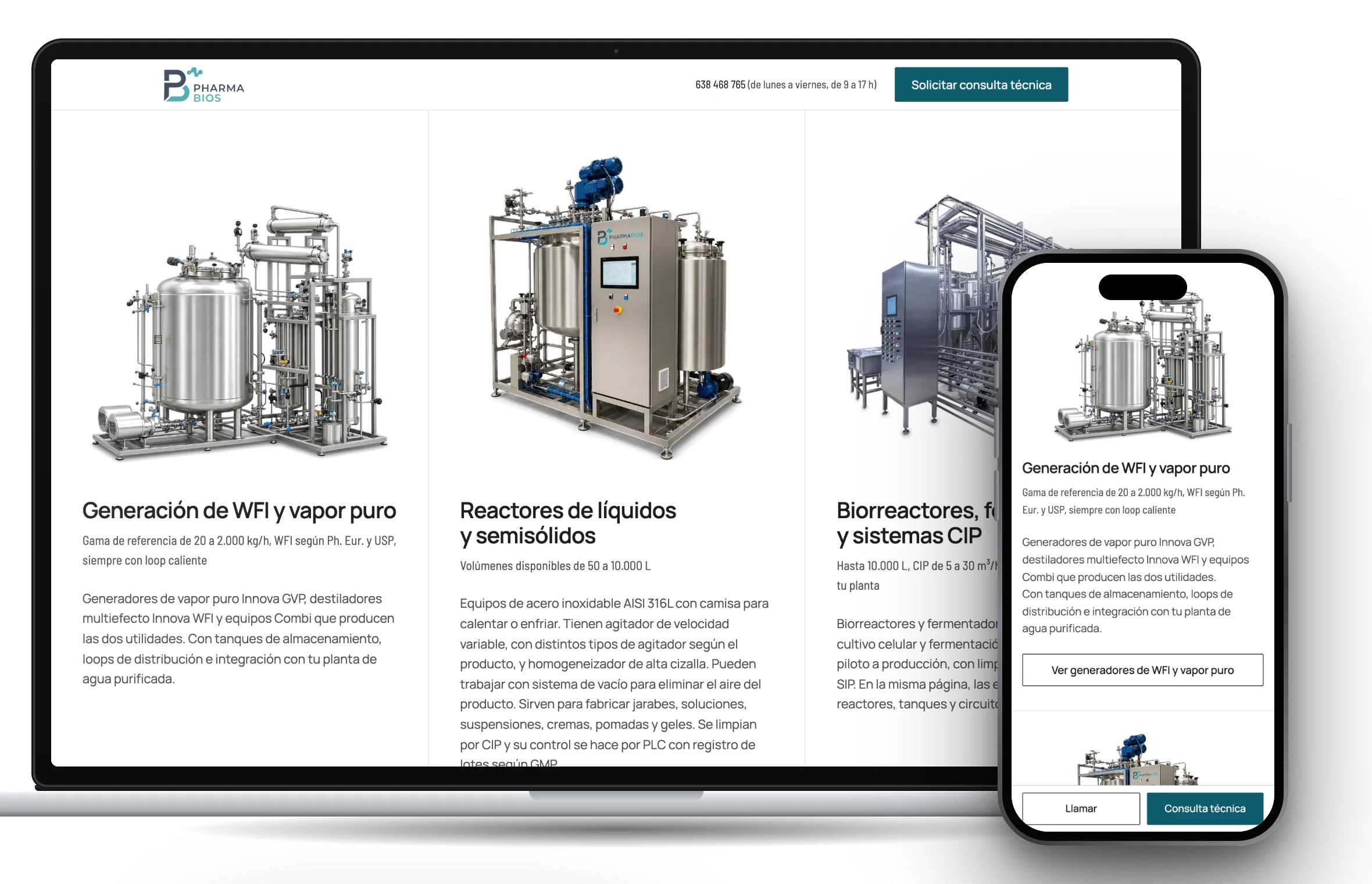
We built three landing pages, one for bioprocess, one for liquid and semi-solid reactors and one for water for injection and pure steam, plus a solutions page that brings them together. We designed them, wrote the copy and coded them ourselves, separately from the rest of the PharmaBios website, so they could be improved without touching anything else.
Each landing page follows the order in which a buyer thinks. A headline that says the same thing the person searched for, and the key data straight away. Who it is for and who it is not for. How the technology works, explained with the name the customer uses and with the technical one too. A capacity table with its limits, and the data sheets to download.
Then, what the supply includes and which documentation is delivered, marked “incluido” or “según oferta” line by line, and how they work, from the first enquiry to factory testing and start-up. At the end, frequently asked questions and a short form that goes straight to the sales team.
Before publishing them, we read them as a buyer would, with three different profiles, and passed PharmaBios the questions needed to fill in what was still missing. They are fast pages. On a phone with a slow connection, the main content shows between 0.94 and 1.65 seconds after opening them. We measured it on 12 November.
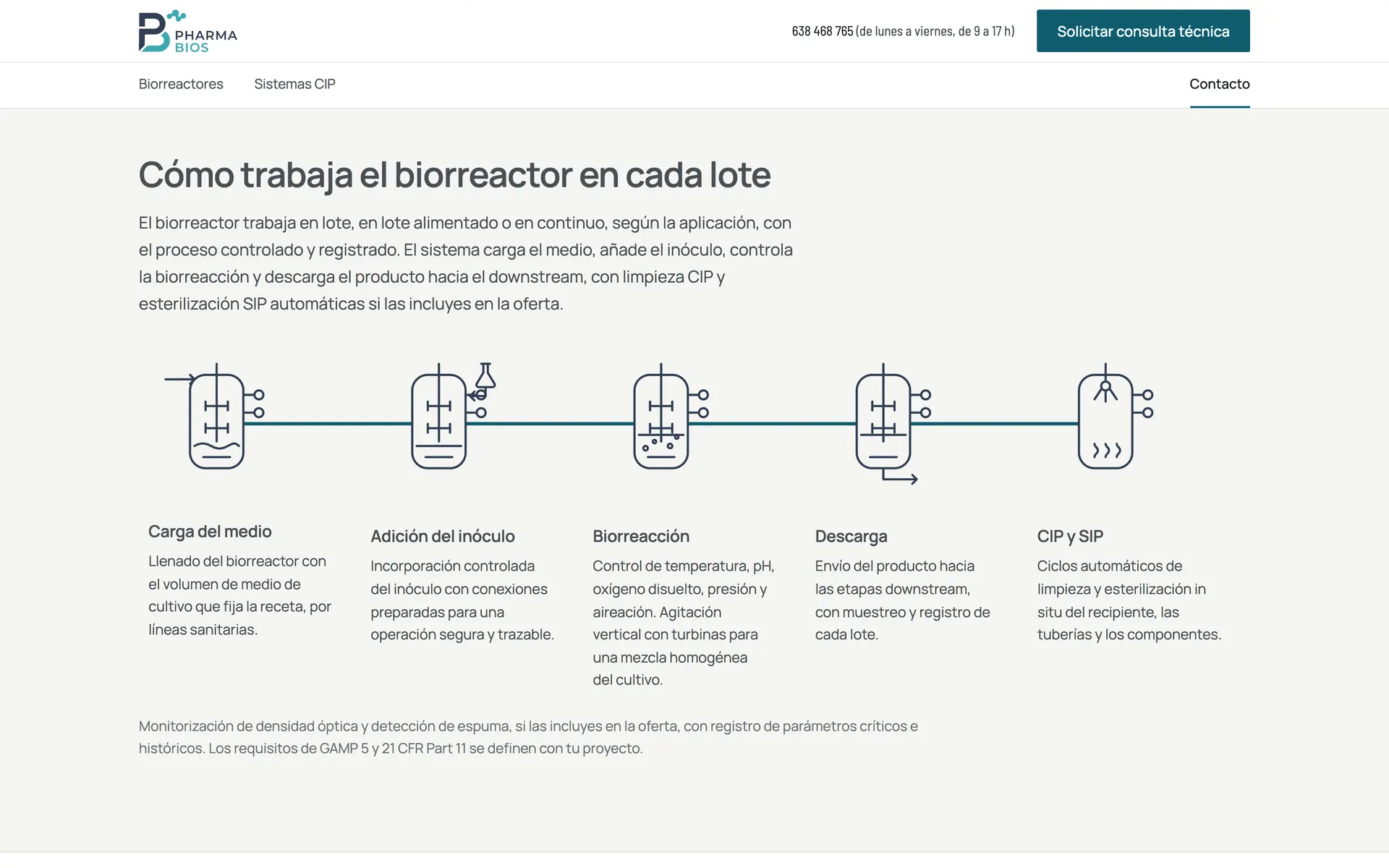
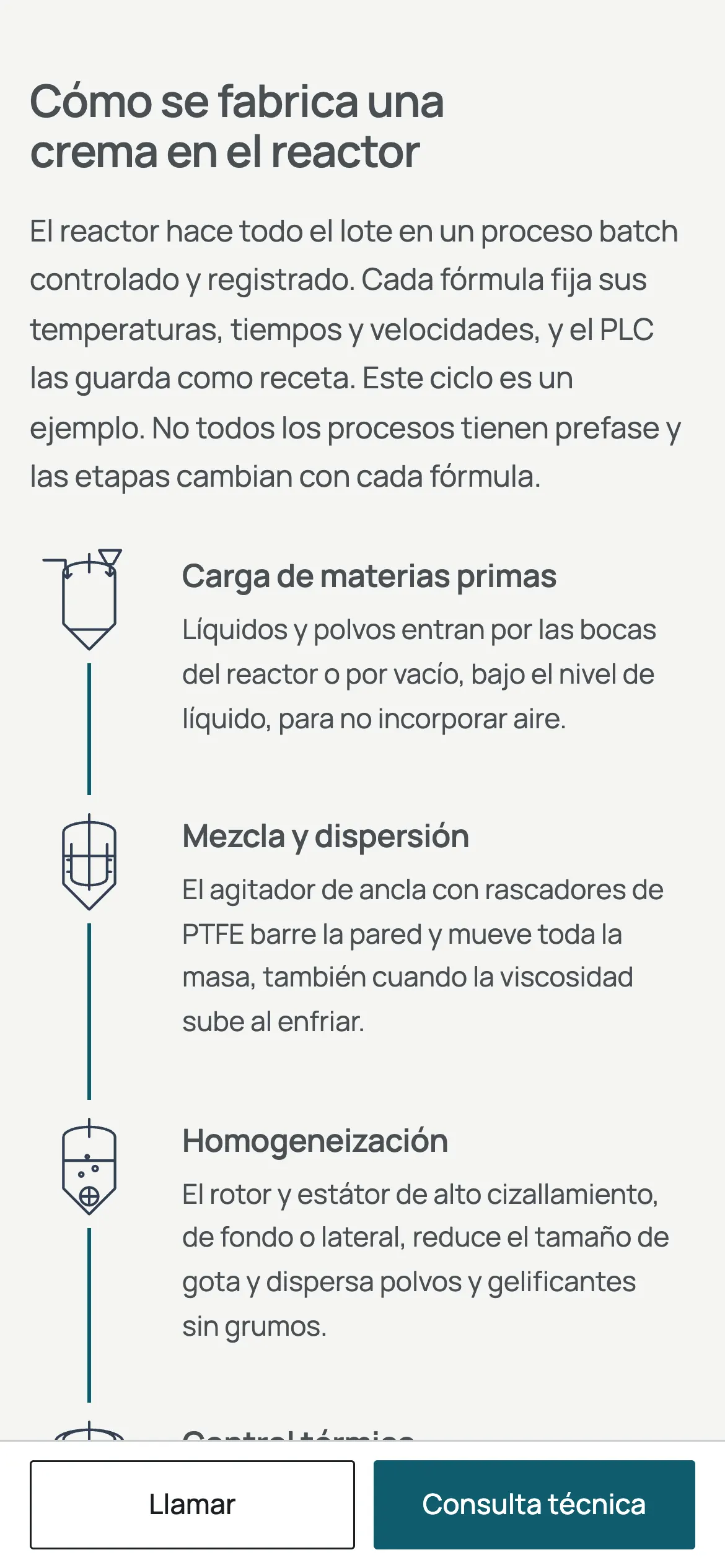
How each unit works, step by step, on the bioprocess landing page on a computer and the semi-solids one on a phone, on 18 November 2026. Screenshots by crida studio. CIP, inside the bioprocess landing page
The CIP systems have no page of their own. The CIP ads lead to their section of the bioprocess landing page, with the configuration table, the data sheet and the form with the technology already chosen.
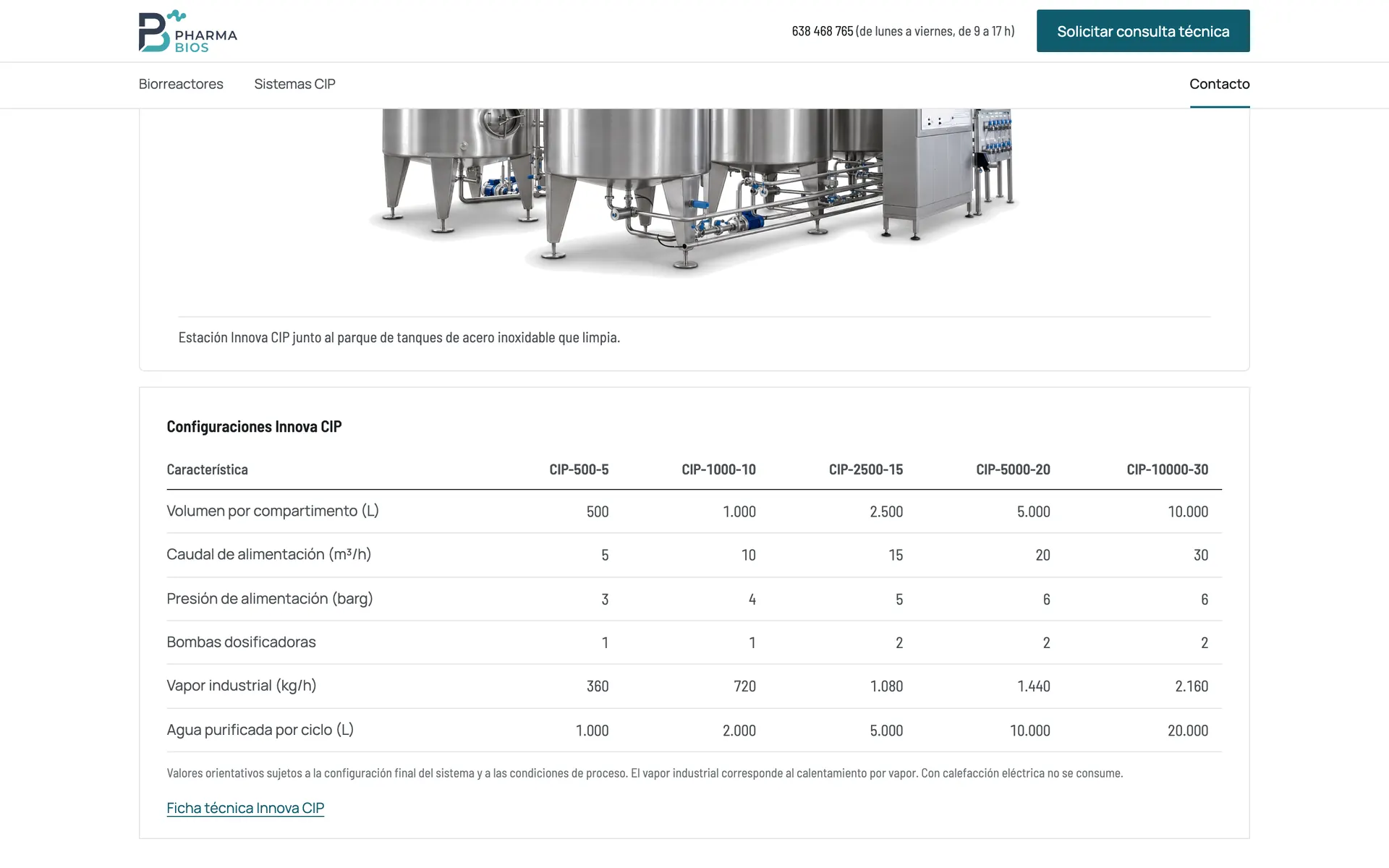
The CIP section of the bioprocess landing page, with the configurations and the data sheet, on 18 November 2026. Screenshot by crida studio. Measuring every lead
Google Ads counts a single primary conversion, the form received. The click to call is counted separately, as a secondary one. Everything goes through Google Tag Manager, with Google consent mode, so that what each visitor chooses in the cookie notice is respected.
On top of that, each lead is saved in the website’s own log, with the page and the search it came from. That way PharmaBios can check one by one what has come in, and we note how long their team takes to reply.
The first lead arrived on 8 November, through the bioprocess landing page, and PharmaBios confirmed it was a good one.
- Form receivedThe only primary conversion Google Ads counts.
- Google Tag ManagerWith consent mode, it respects what each visitor chooses.
- Own logEach lead is saved on the website, with the page and the search it came from.
The click to callCounted separately, as a secondary conversion.How each lead that comes through the landing pages is measured. 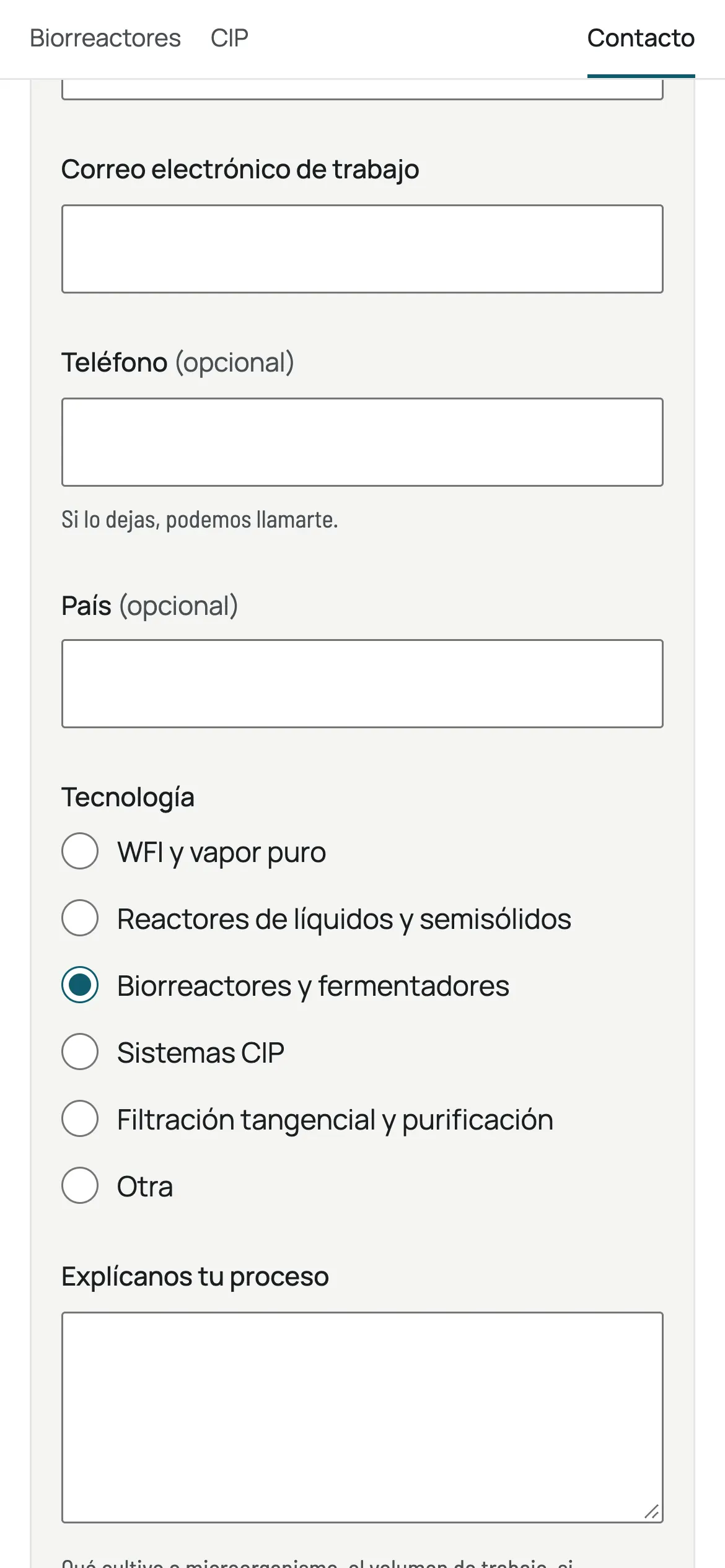
The form of the bioprocess landing page on a phone, with the technology already chosen, on 18 November 2026. Screenshot by crida studio. A Looker Studio report, always up to date
So that PharmaBios never has to wait for a report or ask us for figures, we built them a Looker Studio report, Google’s data dashboard tool, now called Data Studio. It updates itself with data from Google Ads, Google Analytics and Search Console, and from the sheet where every lead is logged.
They open it whenever they like. It has a page with the month’s summary, a week-by-week tracking page with each day’s clicks and cost per click and the detail by product line, one with the searches that brought visits and one with the budget and the pace of spend. And a glossary, so everyone on the team understands each metric without having to ask.
- Monthly summaryThe month’s clicks, cost and leads.
- TrackingEach day’s clicks and cost per click, week by week.
- What they searchThe searches that brought visits.
- Budget and paceHow much has been spent, and how fast.
- GlossaryEvery metric, explained.
The pages of the PharmaBios report, drawn without data. 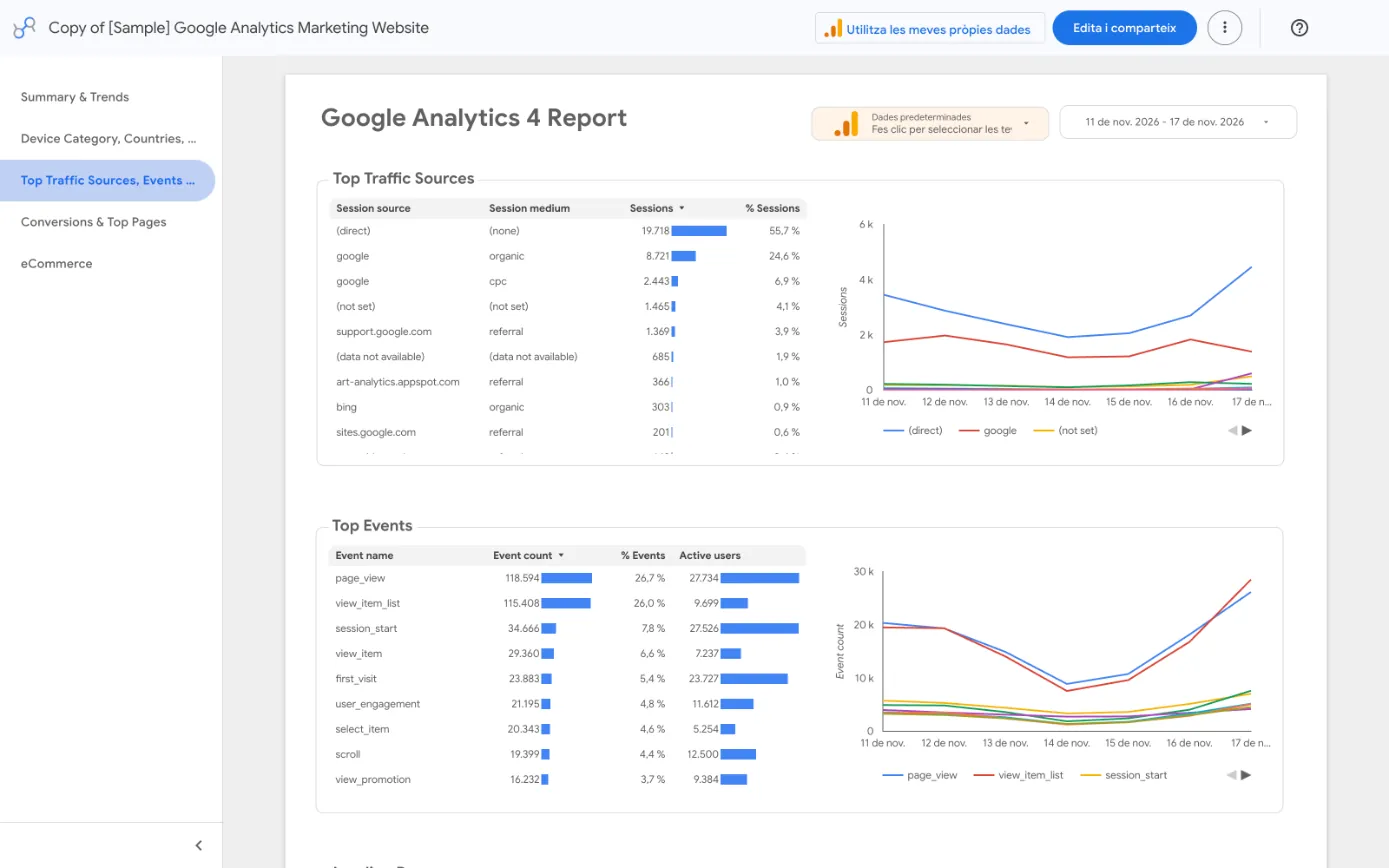
Google’s “GA4 Report” template, with demo data, on a computer. It is not the PharmaBios report, which is private. Screenshot by crida studio. Management, week by week
Every week we review the searches that brought clicks and sort them into equipment that fits, another manufacturer’s brand, outside the range or lab. With that we add negatives, adjust keywords and look at the quality Google gives each ad and each page.
Everything is noted in a tracking sheet that PharmaBios can see, and they have a data report they can check whenever they like. Big changes, such as the budget or the bids, are decided with data and with their yes, and we draw no conversion conclusions until there are enough clicks.
The landing pages keep improving too. For example, on 12 November we changed the semi-solids headline so it said the word people search for, and we made the cookie notice smaller on phones.


The first signals
Before the new campaigns, the search ads missed 46.7% of the times they could have appeared because of ad rank, that is, the position Google gives each ad based on the bid and the quality of the ad and the page. In the first two weeks of the new campaigns, that figure fell to 20.5%. It is the clearest sign that the ads now fit better with what people search for.
We are not giving lead figures yet. With two weeks of campaign they would be too small a picture, and in a sector with few searches it takes more clicks to know what works.
What we delivered
Everything we did for PharmaBios, from the first meeting to the weekly management.
- Initial interview53 questions and a summary of what we took from it.
- Account reviewA report with the proposed improvements.
- Buyer researchAnd more than forty competitor pages.
- Product vocabularyAgreed with them, the same in ads and pages.
- SpecificationOf the new campaigns, before building them.
- Four ad groupsOne per equipment family, and the negative keyword list.
- Three landing pagesAnd the solutions page, with the design, the copy and the code.
- Buyer’s readingOf the landing pages, and the questions to complete them.
- Lead measurementGoogle Tag Manager, consent mode and an own lead log.
- Looker Studio reportWhich updates itself, with its glossary.
- Weekly managementThe searches reviewed and the tracking sheet.
Questions about the project
How much does it cost to run Google Ads for an equipment manufacturer?
We do not say here what PharmaBios pays. As a reference, Google Ads management starts at €790 a month, excluding VAT, and the ad spend is separate. Landing pages are quoted separately.
Why are there no lead figures yet?
Because the new campaigns have been running since 3 November. In a sector with few searches, two weeks are not enough to say what works. We will add them around mid-January, when there are about 300 clicks.
Do you use broad match or AI Max?
Not to begin with. For such specific equipment, phrase and exact match plus a good negative keyword list avoid paying for searches that are not from buyers. We look at it again once there is data.
How to stop Google Ads sending students instead of lab buyers
Do you work with manufacturers outside Girona?
Yes, with companies all over Spain and abroad, remotely.
Credits
- Strategy, Google Ads and measurement
- crida studio
- Landing pages, with the design, the copy and the code
- crida studio
- Equipment, data sheets and equipment photos
- PharmaBios Innova

Published Updated
Do you make industrial equipment?
If you already run Google ads and want them to bring more leads, tell us what you sell and how it is set up now, and we will tell you where we would start.