

On this page
What objective should a digital strategy have?
Selling more is a general direction. To start work, understand who should be reached, which offer makes sense to present and what step the person should take. A quote request, a booking and a commercial conversation need different journeys.
Write the objective as a sentence that can be checked. For example, receiving quote requests for home renovations in the Girona area, or getting bookings to come through the website. If it does not say who, what and which step, it still needs work.
Bring information that helps decisions
There is no need to collect reports without context. Customer questions, the reasons an enquiry goes no further and the material you already have can provide very specific information. Visitor and campaign data needs to be read with its limitations in mind.
Analytics data only captures part of your visits. The cookie guide published by the Spanish data protection agency (AEPD), updated in May 2024, states that analytics cookies are not exempt from the duty to obtain informed consent. The figures therefore depend on who accepts the banner. Read them as a trend.
Must I first decide whether I need SEO, brand work or a website?
It helps to explain the problem before choosing the discipline. Business information can then be used to assess which area needs attention and what depends on other changes. The answer often combines two things, such as the message and visibility, and then the order matters more than the label.
Choose what makes sense to do first
If basic service information is unclear, attracting more visitors may leave the same difficulty in place. If the message is clear but the contact route is unsuitable, the priority may lie in the journey rather than in traffic.
Actions need to relate to a need and the practical capacity to carry them out. Separate what can be done now from what depends on other decisions, such as a price change, a new service line or a new hire.
Want us to look at your case? Leave us your details and we’ll tell you where we would start.
Let's talkDefine who will review the outcome
A plan should identify who prepares material, who makes decisions and what information will be reviewed later. Without those responsibilities, a recommendation can remain a document with no follow-through. Naming people and a review point already changes a great deal.
Review is used to test hypotheses and adjust priorities. The commission can focus on one area if that is what the business needs first. A website, a campaign or a brand change can run in phases, with an owner for each phase.

Do I need analytics data to start?
It is not essential. Customer questions and the reasons an enquiry goes no further already say a lot. If you have analytics, read it as a trend, because analytics cookies require consent and only capture part of your visits. If you do not, note down where enquiries come from.
Five steps to organise before the first meeting
These steps can be done inside the business with the people who know the customers. No special tool is needed. A shared document with the answers is enough to prepare the conversation and to compare proposals using the same criteria.
- Step 1. Write down the change the business needs and the step an interested person should take.
- Step 2. Collect the questions customers ask and the reasons an enquiry goes no further.
- Step 3. Take stock of what is published, what has been tried and what was dropped.
- Step 4. Order the actions by the problem they solve and the real capacity to carry them out.
- Step 5. Name who prepares material, who decides and who will review the outcome.
An example. A joinery in la Selva that wants more enquiries
This example is made up. A family joinery in la Selva makes fitted kitchens and wardrobes and wants more presence online. Once the objective is pinned down, what it needs is quote requests from families renovating their homes around Girona.
Callers almost always ask the same things. Whether the workshop takes small jobs, how long it takes and how the process works. The website has only photographs and a phone number. The problem is messaging and journey. More visitors from ads would fill a page that does not answer those questions.
The priority is clear. First, explain the process and the services on the website, with a form that asks what kind of job it is. Then review the Google Business Profile. According to Google’s guidelines, its name should reflect the business’s real-world name, as customers know it. Ads can wait.
What if the business has several objectives at once?
That is common. Choose one as the main objective for the first phase and write the others down for later. A main objective lets you organise the message, the journey and measurement around it. When objectives compete, it becomes hard to tell what worked.
How to decide where to start
The decision can be made with four questions answered using what you have already collected. Each answer points to one part of the problem. If there is more than one, start with the one that blocks the others, which is often the message.
Having a website is the starting point. According to the Idescat survey on ICT use in companies, 88.9% of Catalan companies with 10 or more employees and internet access have one, and so do 36.0% of those with fewer than 10. What makes the difference is whether it answers what people ask.
- If people who arrive do not understand what you offer or who it is for, the problem is messaging.
- If they understand but cannot find how to request a quote or book, the problem is the journey.
- If the journey works but few people arrive, the problem is acquisition or visibility.
- If enquiries arrive that do not match what you sell, review the offer and the audience.
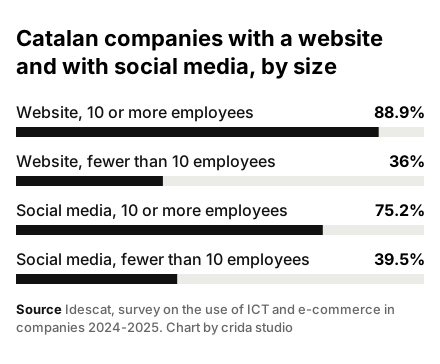
| Indicator and size | Share of companies |
|---|---|
| Website, 10 or more employees | 88.9% |
| Website, fewer than 10 employees | 36% |
| Social media, 10 or more employees | 75.2% |
| Social media, fewer than 10 employees | 39.5% |
