

On this page
What the law says and since when
Article 50(1) of Regulation (EU) 2024/1689 requires providers to make sure that AI systems intended to interact directly with natural persons are designed so those people are informed they are interacting with an AI system. The only general exception is when this is obvious to a reasonably well-informed and observant person, given the context.
Article 113 sets the general date of application at 2 August 2026. The European Commission confirms this in its FAQ on Article 50 and published guidelines on 20 July 2026 to help apply it. The current wording of the article is available on the Commission's AI Act Service Desk.
Which businesses this really affects
Anyone with an AI system talking to customers. The Commission's examples are chatbots, AI agents and avatars. Think of a clinic in Girona answering on WhatsApp through a bot, or a restaurant on the Costa Brava handling bookings with an assistant.
The Regulation separates two roles. The provider is whoever develops the system and places it on the market under its own name (Article 3(3)). The deployer is whoever uses it under its own authority (Article 3(4)). The duty in Article 50(1) sits with the provider, but the notice is what your customer sees on your website, so it is worth checking it yourself.
The "obvious" exception exists, but the Commission says in its FAQ that it should be interpreted restrictively. If your chatbot has a person's name and writes like a person, the safe choice is to show the notice.
My chatbot only has scripted answers, no AI. Does this apply to me?
The Regulation talks about AI systems as defined in Article 3(1). A fixed question tree that neither learns nor generates text may not fit that definition, but your tool provider has to confirm that. If in doubt, show the notice anyway. It costs one sentence.
What the notice has to look like
Article 50(5) requires the information to be clear and distinguishable, at the latest at the first interaction, and to meet the applicable accessibility requirements. It does not prescribe wording or design. That is up to you, as long as it arrives at that first interaction. In practice, three things together work well.
Do not bury it in the privacy policy alone. The rule talks about the first interaction, and nobody reads a privacy policy before asking for opening hours or whether there is a table free for dinner.
- A line in the chatbot's first message. For example "Hi, I am the clinic's virtual assistant. I am an AI. If you would rather talk to a person, type person".
- A fixed label in the chat window, such as "AI assistant", that stays visible as the conversation goes on.
- On WhatsApp or the phone, the notice inside the first message or the first spoken line, because there is no window or label there.

I bought the chatbot from an outside company. Who is responsible?
Article 50(1) puts the duty to design the notice on the system's provider, and you are the deployer under Article 3(4). But the notice appears on your website and talks to your customers. Ask the provider how they comply, check it yourself and keep their answer in writing.
Want us to look at your case? Leave us your details and we’ll tell you where we would start.
Let's talkWhat if you use AI to write copy or make images
Article 50 also covers generated content. Paragraph 2 requires providers of tools that generate text, images, audio or video to mark their output in a machine-readable format. The Commission explains that tools already on the market before 2 August 2026 have until 2 December 2026 to comply.
Paragraph 4 does concern you if you publish. Anyone using AI to generate or manipulate images, audio or video that amount to a deepfake must disclose that the content is artificial. And anyone publishing AI-generated text to inform the public on matters of public interest must say so, unless a person has reviewed it and someone holds editorial responsibility.
Article 50(4) only covers deepfakes and text on matters of public interest. A product sheet or a sales email is not mentioned there. A town council publishing news items would do well to record in writing who reviews the text and who is responsible for it.
Is it enough to explain it in the privacy policy?
Article 50(5) says the information must be clear and distinguishable and reach the person at the latest at the first interaction. A sentence inside a legal page is not what the customer sees when they open the chat. Put it in the first message and in the chat window.
What happens if you do not comply
Article 99(4)(g) lists the transparency obligations of Article 50 among those that can be fined with up to 15 million euros or, for a company, up to 3 % of its total worldwide annual turnover for the previous financial year, whichever is higher. Article 99(6) says that for SMEs, including start-ups, the lower of the two figures applies.
Article 99(7) lists what is weighed when setting a fine, such as the nature, gravity and duration of the infringement and its consequences, the size and annual turnover of the company and whether it was intentional or negligent.
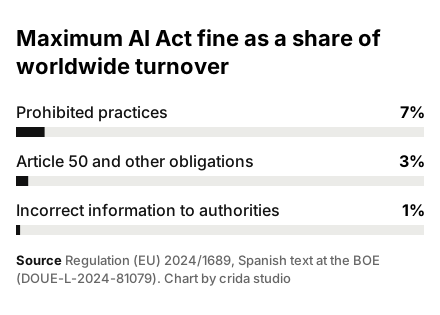
| Type of infringement | Ceiling on turnover |
|---|---|
| Prohibited practices | 7% |
| Article 50 and other obligations | 3% |
| Incorrect information to authorities | 1% |
Does a voice assistant on the phone have to say it too?
Article 50(1) does not mention specific channels. It speaks of AI systems intended to interact directly with natural persons, wherever that happens. If an AI-generated voice answers your phone, the simplest route is for the first sentence to say so and offer to pass the call to a person.
What to check this week
If you have AI talking to customers, this list takes an afternoon. Just open the chatbot the way a new customer would, write down what they see and ask your provider about anything you cannot check yourself.
- Open the chatbot as a new customer and read the first message. Does it say it is AI?
- Check that the label is visible on mobile and with a screen reader, because Article 50(5) refers to accessibility requirements.
- Review the website, but also the WhatsApp bot and the phone assistant.
- Ask your chatbot provider in writing how they comply with Article 50 and keep the answer.
- Note the date of the review and who did it.
