

On this page
What visitors look for on an equipment manufacturer website
People who land on a bioreactor or TFF system manufacturer's website usually have a live project. It might be a process development scientist who needs to scale up, an engineer planning a pilot plant or a buyer comparing suppliers. None of them wants to start with the company history.
The home page should say in one sentence what you make, for which scales and for which processes. Then it should send each role to the right page. If finding a volume range takes three menus, the buyer goes back to Google and clicks on the next manufacturer.
Pages by scale, from lab to GMP production
Scale is the buyer's first filter. Each lab, pilot or production page should give the volume range and the single-use and stainless steel options. It should also say what stays the same when the customer moves up a scale, such as the control software, the sensors or the vessel geometry.
Today the TECNIC Bioprocess Solutions website organises its bioreactors this way, from 0.5 to 2,000 litres. It separates single-use from reusable systems and offers guides by application, technology and scale. Buyers can follow that structure without having to ask anyone.
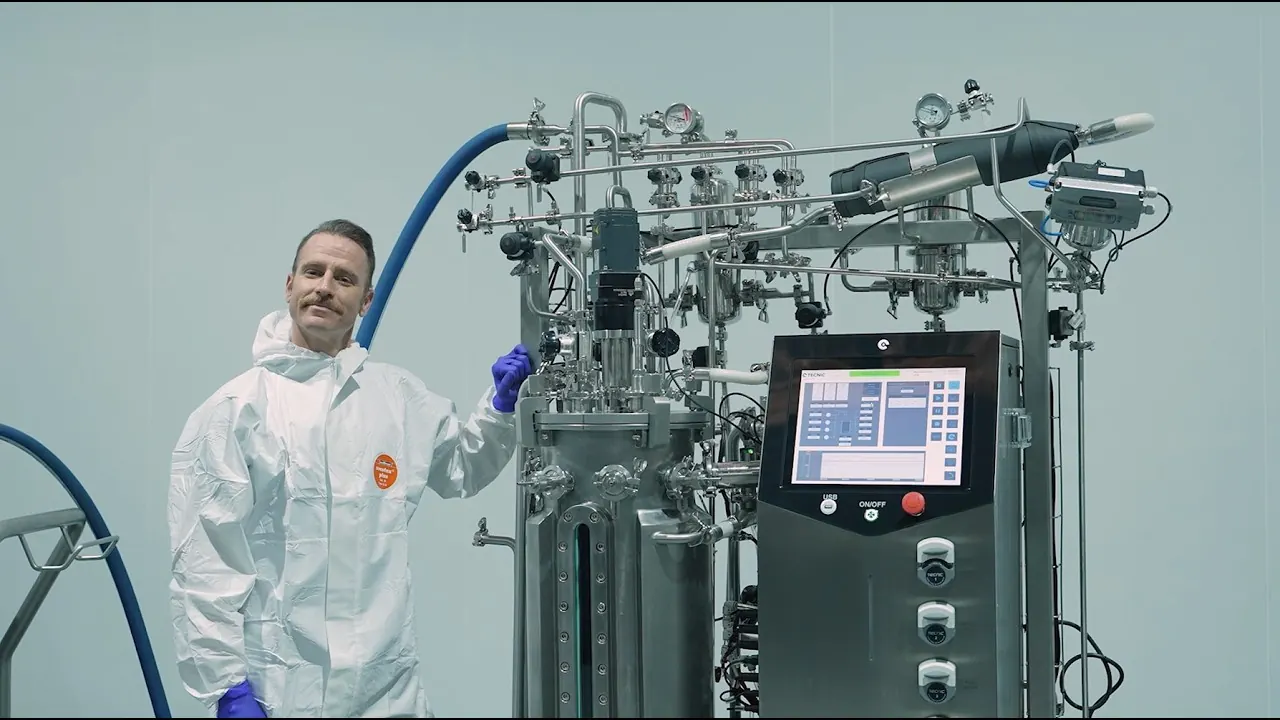 Play the video. Bioprocess equipment for pilot plants - TECNIC
Should a bioprocess equipment website show prices?
Usually not, because each system is configured around the customer's scale, sensors, software and documentation needs. What does help is explaining what drives the price and offering a short quote request form. That way the buyer knows what to prepare and your sales engineer gets the information needed to reply properly.
Application pages, from mAbs to cell and gene therapy
Many buyers search by process rather than by product. They type cell culture for monoclonal antibodies, microbial fermentation or vaccine production. An application page explains the challenge of that process, which configuration fits and what proves it, such as an application note or a case study told without the customer's name.
Be careful with claims here. GMP applies to whoever manufactures the medicinal product, and they are responsible for qualifying the equipment at their site. A line like GMP validated equipment can make quality teams suspicious. It works better to explain how the system helps them comply and which documents come with it.
Want us to check whether your website takes each role to the page they need? Leave your details and we will tell you what we would change first.
Review my websiteValidation documents help you sell too
Section 3 of Annex 15 of the EU GMP guidelines sets out the qualification stages for equipment. It starts with the user requirements specification (URS), moves through design qualification and factory and site acceptance testing (FAT and SAT), and goes on to IQ, OQ and PQ. Quality and validation teams will read all of it before they sign off.
Your website can get that work started with a page of its own. A sample table of contents for an IQ and OQ protocol says more than a paragraph of adjectives. These are the points validation teams ask about most.
- What the documentation package includes and which languages it comes in.
- How the FAT is run, where it takes place and whether the customer can attend.
- Which documents the customer receives to prepare IQ and OQ.
- Which audit trail, record keeping and access control features the software has.
Which languages should an equipment manufacturer website be in?
If you sell outside your home market, English is essential, as it is the common language of buyers, technical publications and industry trade shows. Next come the languages of the markets where you have sales staff or distributors, such as German if Germany is a priority. A few well maintained languages beat many that were translated once and then forgotten.
A clear path to a quote for every role
A single generic contact form loses enquiries. Researchers want to download a datasheet, engineers want to talk to an application specialist and procurement wants a quote. Each path should ask only for what your sales team needs to give a good answer, such as scale, process, technology and when the system is needed.
David Monje, founder of crida studio, led marketing at TECNIC for four and a half years. There he built the marketing function from scratch and set up B2B funnels with SEO, SEM and automation. On a manufacturer's website, the funnel starts when you know which role left their details and continues with follow-up designed for that role.
Can we publish case studies if we work under NDAs?
Yes, as long as you explain the problem and the solution without naming the customer or sharing details of their process. Give the type of company, the scale, the application and what changed with the equipment. Before publishing, it is wise to get the customer's written approval, even if their name appears nowhere.
How Google and AI answers find you
Google says its systems reward helpful, reliable content made for people. The questions it suggests for reviewing content include whether it shows first-hand expertise, whether it is clear who wrote it and whether it has easily verified factual errors. In bioprocessing, that means pages signed by engineers and specialists with a real name and role.
Product pages can also carry structured data. Google offers product markup for pages where people cannot buy directly, which covers most equipment sold on quotation. It helps the search engine understand what each system is, although Google does not guarantee it will show rich results.
