

On this page
What the numbers say about 66 bioprocess manufacturer websites
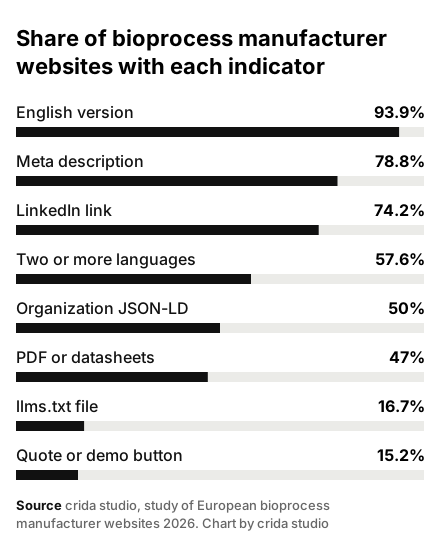
European bioprocess equipment makers have the technical basics and English covered, and fall short when it comes to selling. 61 of 63 (96.8%) redirect to HTTPS on their own, 62 of 66 (93.9%) offer English and 52 (78.8%) have a meta description. By contrast, only 10 (15.2%) have a quote or demo button and none has all five sales elements we looked for.
The sample is 79 Europe-based makers of bioreactors, filtration, single-use systems, chromatography, sensors and process plants. We could read the home page of 66 (83.5%). 45 of the 79 are headquartered in Germany, Austria or Switzerland, which weighs on the overall figures.
| Indicator | Websites | Share |
|---|---|---|
| HTTPS enforced (http redirects to https) | 61 | 96.8% |
| English version | 62 | 93.9% |
| Meta description | 52 | 78.8% |
| Structured data (JSON-LD) | 44 | 66.7% |
| Two or more languages | 38 | 57.6% |
| hreflang tags | 36 | 54.5% |
| Organization JSON-LD | 33 | 50.0% |
| Contact or email link | 65 | 98.5% |
| LinkedIn link | 49 | 74.2% |
| PDF or link to datasheets, catalogue or downloads | 31 | 47.0% |
| Form on the home page | 20 | 30.3% |
| llms.txt file | 11 | 16.7% |
| Quote, offer or demo button or link | 10 | 15.2% |
| robots.txt blocking an AI bot | 4 | 6.1% |
| Indicator | Share of websites |
|---|---|
| English version | 93.9% |
| Meta description | 78.8% |
| LinkedIn link | 74.2% |
| Two or more languages | 57.6% |
| Organization JSON-LD | 50% |
| PDF or datasheets | 47% |
| llms.txt file | 16.7% |
| Quote or demo button | 15.2% |
How we chose the companies and how we measured
There is no census of European bioprocess equipment makers, so we cross-checked the public exhibitor lists of BioProcess International in Europe and the United States from 2023 to 2026, ACHEMA 2027 and analytica 2026, plus the bionity.com and AseBio directories. We kept own-brand manufacturers headquartered in Europe and left out distributors, CDMOs, software firms and subsidiaries of non-European groups.
Our own program read the home page, robots.txt and llms.txt of each site on 1 November 2026, without running JavaScript, one request at a time and with pauses. It identifies itself as crida studio and respects robots.txt. Of the 13 sites we could not read, 9 sit behind bot protection, which we did not try to get around.
This is neither a census nor an audit. Anything loaded with JavaScript is invisible to us, so the figures are minimums. The sales index is our own yardstick. We give no results by company size because no public source covers enough firms. The sample includes one crida studio client and the company where its founder used to work. Like the rest, they are not named.
Can I find out how my company’s website did?
Yes, if you work for the company. The page and the CSV files only contain aggregates by country group and segment, because the study is not meant to single out any manufacturer. Ask us through the contact form and we will explain what we saw on your home page, without publishing it anywhere.
How many languages they offer and where the gaps are
English is almost universal, but most sites stop there or shortly after. 62 of 66 (93.9%) offer English and 38 (57.6%) two or more languages. 28 (42.4%) show a single language, nearly always English, and 36 (54.5%) use hreflang, the tag that tells Google which version is meant for each language.
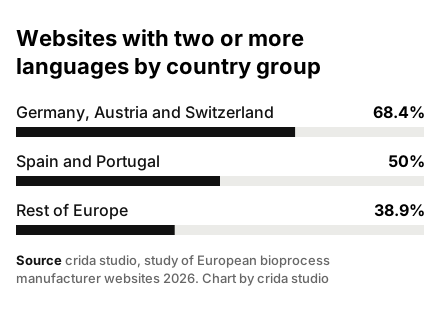
Companies headquartered in Germany, Austria and Switzerland offer more languages. 26 of 38 of their sites (68.4%) have two or more, against 5 of 10 (50.0%) in Spain and Portugal and 7 of 18 (38.9%) in the rest of Europe. For a maker selling across several countries, speaking the buyer’s language can still set it apart.
| Country group | Websites analysed | English | Two or more languages | hreflang |
|---|---|---|---|---|
| Germany, Austria and Switzerland | 38 of 45 | 35 (92.1%) | 26 (68.4%) | 23 (60.5%) |
| Spain and Portugal | 10 of 10 | 9 (90.0%) | 5 (50.0%) | 6 (60.0%) |
| Rest of Europe | 18 of 24 | 18 (100.0%) | 7 (38.9%) | 7 (38.9%) |
| Total | 66 of 79 | 62 (93.9%) | 38 (57.6%) | 36 (54.5%) |
| Country group | Share of websites |
|---|---|
| Germany, Austria and Switzerland | 68.4% |
| Spain and Portugal | 50% |
| Rest of Europe | 38.9% |
Why is my company not in the study?
Because it only covers Europe-based manufacturers that appear in the exhibitor lists and directories we used, from BioProcess International, ACHEMA 2027, analytica 2026, bionity.com and AseBio. Distributors and the European subsidiaries of groups headquartered outside Europe are not included either.
If your company’s website is one of the 66 we analysed, we will send you how it did on each indicator and where we would start.
Ask for your resultHow they invite quote requests and what buyers can download
Nearly every home page has a contact link, 65 of 66 (98.5%), but few go further. Only 10 (15.2%) have a button or link in the HTML to request a quote, an offer or a demo, or to talk to an expert, and 20 (30.3%) have a form on the home page. For a buyer who knows what they need, a plain contact link is too generic.
49 of 66 (74.2%) link to LinkedIn and 31 (47.0%) to a PDF or to datasheets, a catalogue or downloads. Our sales index runs from 0 to 5 and gives one point each for English, a quote or demo button, LinkedIn, datasheets and company or product structured data. The average is 2.8, 19 sites score four and none scores five.
| Segment | Websites analysed | Quote or demo | PDF or datasheets | Sales index (0 to 5) | |
|---|---|---|---|---|---|
| Bioreactors, fermenters and cell culture | 23 | 3 (13.0%) | 15 (65.2%) | 7 (30.4%) | 2.5 |
| Filtration, TFF and chromatography | 15 | 2 (13.3%) | 13 (86.7%) | 9 (60.0%) | 3.2 |
| Single-use and fluid handling | 10 | 2 (20.0%) | 7 (70.0%) | 6 (60.0%) | 3.0 |
| Bioprocess sensors and control | 11 | 3 (27.3%) | 9 (81.8%) | 3 (27.3%) | 2.6 |
| Plants, skids and engineering | 7 | 0 | 5 | 6 | 3.0 |
What does the sales index mean?
It is our own yardstick, from 0 to 5. It gives one point for each element that helps an international buyer from the home page, an English version, a quote or demo button, a LinkedIn link, datasheets or a catalogue, and company or product structured data. It does not say whether a site sells well.
What Google and AI assistants can read
Structured data is there, but it often says little. 44 of 66 (66.7%) include JSON-LD, often what the content management system adds by default, and 33 (50.0%) state who they are with the Organization type. Only 1 (1.5%) describes a product with the Product type, which is what helps a search engine or an AI understand what the company makes.
11 sites (16.7%) already have an llms.txt, the file that summarises a website for language models. Only 4 (6.1%) block at least one of GPTBot, ClaudeBot, PerplexityBot, Google-Extended or CCBot, and none blocks all five. However, 9 of the 79 sites (11.4%) would not let our clearly identified robot read their home page.
How was each website measured?
With a program that downloads the home page, robots.txt and llms.txt of each site and reads the HTML for a fixed set of indicators. It does not run JavaScript, identifies itself as crida studio, respects robots.txt and makes one request at a time, with pauses. If a site blocks it, we do not force our way in and report it as not analysed.
What an equipment maker can check on its own website
Use this list to go through your home page against the study criteria. Almost everything can be checked by opening the site and its source code, and fixed from the content management system. Our guide to bioprocess equipment manufacturer websites covers each element in more detail.
The aggregates by country group and segment can be downloaded as CSV files from the links below. They contain no data on individual companies and let you compare your own group or simply rerun the numbers.
- A visible quote or demo button on the home page, as well as the contact link.
- Versions in your markets’ languages, each with its hreflang tag.
- Datasheets and catalogues linked from the home page.
- Organization structured data across the site and Product data on each equipment page.
- An llms.txt file that sums up what you make, for which processes and at which scales.
- A robots.txt file and bot protection that let through the search engines and AI assistants you want.
- A meta description on every page, a single H1 and a LinkedIn link.
