

On this page
Who makes up the BioRegion of Catalonia in 2025
The BioRegion of Catalonia has 1,650 companies in 2025, up 8.3% on the previous year, plus 94 research institutions. 90% of the companies are SMEs and 93.4% are in Barcelona. More are setting up outside the metropolitan area, mainly in Girona. According to Biocat's company map of December 2025, Girona already hosts nearly 3% of them.
Biocat's ecosystem map splits the companies by subsector. There are 423 biotech companies, 259 in digital health, 238 in medtech and 130 in pharma. It also counts 279 professional services and consulting firms, 81 investors and 240 suppliers. Those 240 may be your competitors or your partners, so find out who they are before you enter.
What does this mean for marketing? If nine in ten companies are SMEs, many of your buyers will be small firms with few decision makers and a tight budget. With buyers like these, a demo or a good conversation at a trade show can count as much as a campaign.
A record €517 million for health startups and scaleups
Investment in Catalan health startups and scaleups reached €517 million in 2025, up 43% on 2024 and 7% above the previous peak in 2022. Biotech raised €347 million, 68% of the total. Medtech took €92 million and digital health €71 million.
Venture capital contributed €327.6 million across 38 deals, the lowest deal count in recent years. The top five rounds make up 47% of the total. So fewer companies have fresh money, but the rounds are bigger. Competitive public grants also hit a record, at €124.3 million.
A startup that closes a round may use it to move from the lab to a pilot plant. If it does, it will need bioreactors, purification systems, consumables or CDMO capacity. Follow funding news from Biocat and the investors. That way your message can land while the company is planning the purchase, before it picks a supplier.
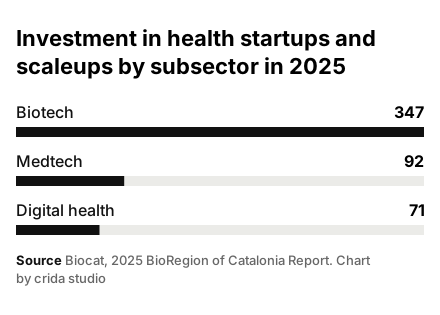
| Subsector | Millions of euros |
|---|---|
| Biotech | 347 |
| Medtech | 92 |
| Digital health | 71 |
How many life sciences companies are there in Catalonia?
According to Biocat's 2025 BioRegion of Catalonia Report, 1,650 companies, up 8.3% on the previous year, plus 94 research institutions. 90% are SMEs and 93.4% are in Barcelona. The figure includes service firms, consultancies, investors and suppliers. 423 of them are biotech companies.
Research centres and clinical trials buy differently
Catalonia has 5,768 active clinical trials in 2025, 92% of the activity in Spain, and Biocat ranks it fourth in Europe for active trials. The clinical pipeline holds 71 assets in development, 51 molecules and 20 advanced therapies, almost double the 2020 figure. That can mean work for CROs, CDMOs, testing labs and consumables suppliers.
A research centre does not buy the way a company does. It may pay from a project budget tied to a grant call, and the end user is the research group. So it pays to have complete technical datasheets, scientific references and paperwork ready to help them justify the purchase.
Want us to look at which BioRegion segment fits your product best? Leave your details and we will talk it through.
Let's lookA different message for each type of buyer
With these figures, we suggest splitting your marketing plan into at least four groups. Each one has a different question in mind and needs its own page, its own emails and its own arguments. That way you stop talking to everyone the same way.
Catalonia also exported €9.165 billion worth of life sciences and healthcare products in 2024, 45.7% of Spain's total. The top destinations are Switzerland, Germany, France and the United States. If one of your customers exports to those markets, expect them to ask for supplier documentation that meets international standards.
- Biotech and medtech SMEs. They tend to want equipment that works from day one, local support and a clear quote. Short case studies and demos.
- Research centres and hospitals. They may buy with project funds. Have complete datasheets, reference publications and documents ready to justify the purchase.
- Startups that just closed a round. If they move from lab to pilot scale, they will look for equipment that scales. Talk about scale-up, delivery and technical support.
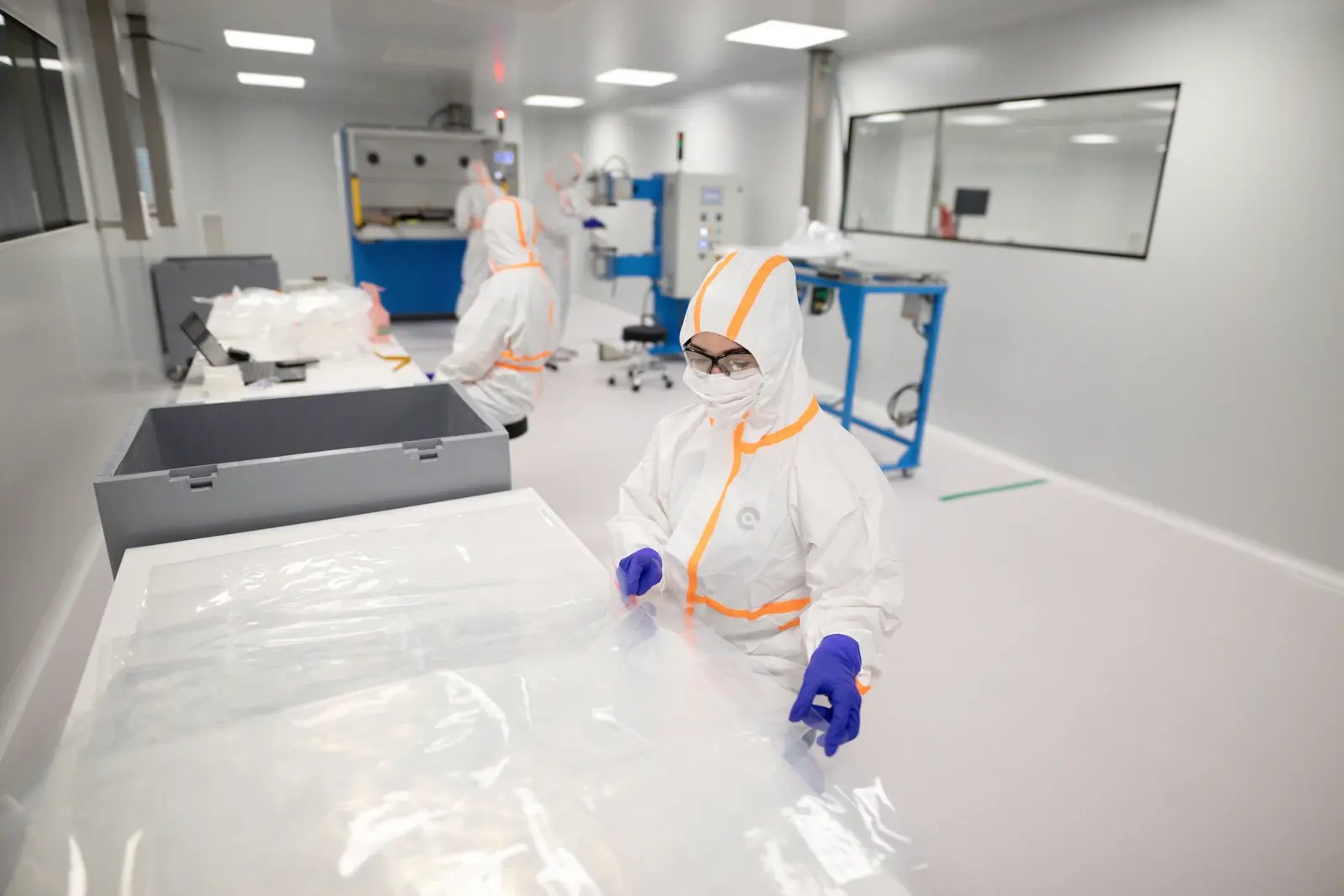
- Pharma plants. They buy with GMP, URS, FAT and SAT and through a buying committee. Your content has to answer engineering, quality and procurement at once.
How much was invested in Catalan health startups in 2025?
Biocat counts €517 million in 2025 for health startups and scaleups, a record. Biotech raised €347 million, medtech €92 million and digital health €71 million. Venture capital put in €327.6 million across 38 deals, and the five largest rounds account for 47% of the total.
A website in three languages and a presence at events
If you want to sell in Catalonia, a website in Catalan, Spanish and English helps. 82% of the venture capital raised in 2025 involved international investors, and English is the norm in many research and startup teams. With SMEs and plants, on the other hand, sales and service may work better in Catalan or Spanish.
Trade shows and sector events are where relationships are built. Biocat presented its 2025 report on 19 February 2026 to a record turnout. BioSpain and Farmaforum attract different audiences, as our guide to the two shows explains. Prepare a message for each segment before you go and follow up with your contacts the week after.
Do I need a Catalan-language website to sell to the sector in Catalonia?
It is not mandatory, but it helps. Research teams and startups work a lot in English, and 82% of the venture capital raised in 2025 involved international investors. With SMEs and plants, service and procurement may work better in Catalan or Spanish. A website in all three languages covers both cases.
What each figure in the report actually counts
The report covers the whole life sciences and healthcare sector, not just biotech. The 1,650 companies include service firms, consultancies, investors and suppliers. Before you work out how many potential customers you have, filter for your subsector. Our market analysis guide compares this figure with AseBio's.
The €517 million includes venture capital, competitive grants, venture debt, stock market funding and crowdequity, raised by startups and scaleups. As for exports, 91% are pharmaceutical products, so the figure says little about lab equipment. Biocat notes that company creation figures for the last two years are provisional. Always quote each figure with its year and what it covers.
