

On this page
Who sponsors advanced therapy trials in Spain
Most cell and gene therapy trials active in Spain are sponsored by industry. Of the 81 we counted, 62 (76.5%) have a lead sponsor in the registry’s industry class. 18 are led by hospitals, research institutes and foundations or individual investigators, and 1 is in the network class. There are 32 different industry sponsors.
The count covers CAR-T, other cell therapies, mesenchymal cells and gene therapies using AAV or lentiviral vectors. Every trial has at least one Spanish site and is recruiting, not yet recruiting, active but not recruiting, or enrolling by invitation. We count trials, not patients or purchasing volume.
Which phase the trials are in
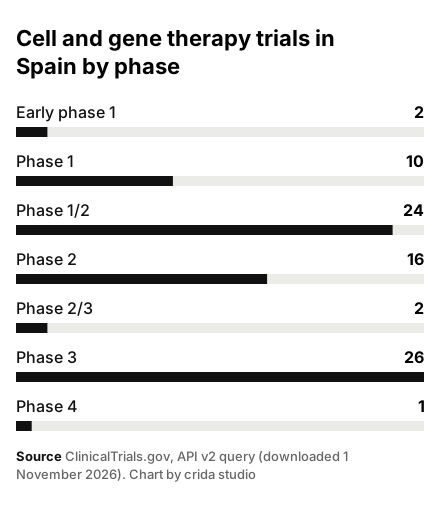
Almost half of the trials are in early phases. 36 of the 81 (44.4%) are early phase 1, phase 1 or phase 1/2, while 26 (32.1%) have already reached phase 3. The rest are 16 in phase 2, 2 in phase 2/3 and 1 in phase 4.
Phase 3 belongs almost entirely to industry, with 25 of the 26 trials. Non-industry sponsors cluster at the start. They hold both early phase 1 trials, 4 of the 10 phase 1 trials, 7 of the 24 phase 1/2 trials counting the one in the network class, and 5 of the 16 phase 2 trials.
| Phase | Trials |
|---|---|
| Early phase 1 | 2 |
| Phase 1 | 10 |
| Phase 1/2 | 24 |
| Phase 2 | 16 |
| Phase 2/3 | 2 |
| Phase 3 | 26 |
| Phase 4 | 1 |
How many cell and gene therapy trials are there in Spain?
Based on our ClinicalTrials.gov download of 1 November 2026, there are 81 active interventional cell and gene therapy trials with at least one site in Spain. It is not an exact total, because this registry does not cover every trial authorised in the country and the term-based classification is our own.
Which Spanish cities host the most trials
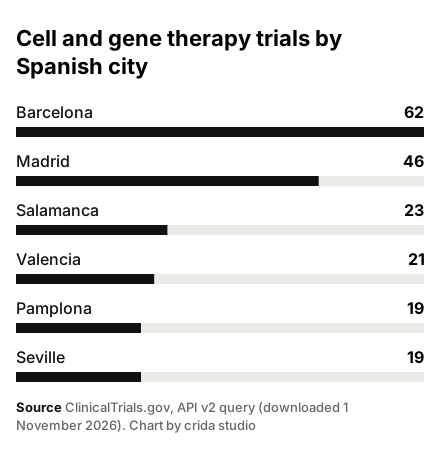
Barcelona and Madrid host the most trials. Barcelona has a site in 62 of the 81 trials and Madrid in 46. Next come Salamanca with 23, Valencia with 21, and Pamplona and Seville with 19 each. Santander has 12, Córdoba 10, Badalona 8 and Málaga 7.
Each trial counts once per city, even if it uses more than one hospital there. Cities are taken as written in the registry, which is why Badalona appears separately from Barcelona. For a supplier based in Girona or elsewhere in Catalonia, a large share of this activity is close to home.
| City | Trials |
|---|---|
| Barcelona | 62 |
| Madrid | 46 |
| Salamanca | 23 |
| Valencia | 21 |
| Pamplona | 19 |
| Seville | 19 |
Want us to check which of these sponsors fit what you sell? Leave your details and we will tell you where we would start.
Check my caseTrials run by hospitals and foundations themselves
Trials with sites only in Spain are mostly academic. There are 20 of them out of 81, and 17 have a non-industry sponsor. Put another way, 17 of the 19 non-industry trials run only in Spain, while just 3 of the 62 industry trials are Spain-only.
The registry shows clear examples. Fundació Clínic per a la Recerca Biomèdica is listed as lead sponsor of the CAR-T trials ARI0002h, in phase 2, and ARI0003, in early phase 1. Hospital Infantil Universitario Niño Jesús in Madrid sponsors AloCELYVIR, in phase 1/2. Here the sponsor is the hospital or foundation itself, which makes it a potential buyer or partner.
Why does it matter whether the sponsor is a company or a hospital?
Because it changes who buys. In an industry trial the hospital treats the patients, but decisions on production equipment and consumables may sit with the sponsor or its CDMO, outside Spain. In an academic trial the hospital or foundation may develop its own product and can become a customer or a partner.
How to use this data in your marketing
Read from a marketing angle, the data points to two audiences. In an industry trial, the hospital is where the trial runs, but decisions on equipment and consumables may sit at the sponsor’s headquarters or its CDMO, which may be outside Spain. In an academic trial, the hospital or foundation may be the buyer or the partner.
So it pays to split your accounts. Most of the 32 industry sponsors are global accounts, reached at headquarters and often in English. Hospitals and foundations running their own trials, mainly in Barcelona and Madrid, are local accounts where direct contact and site visits make sense.
- Prioritise accounts from the trial list, starting with academic sponsors in phase 1 and 1/2.
- Build a LinkedIn list of cell manufacturing, quality and procurement people at hospitals and foundations that sponsor trials.
- Tailor the message to the buying committee, with GMP and quality for foundations and scale-up and supply for industry.
- Pick trade shows where both audiences attend and use the trip to visit sites in Barcelona and Madrid.
- Publish content built on data like this and refresh it every year with a new download.
How often is it worth repeating this count?
Trials open, change status and close all year round, so an account list built from this data soon goes stale. With the query and filters described in the method section, you can repeat the download before a trade show, a campaign or the annual sales plan, and see which sponsors have joined or dropped out.
How we counted and what the data does not say
We used the ClinicalTrials.gov API v2, downloaded on 1 November 2026, with registry data up to 30 October. We filtered by site in Spain and by status (recruiting, not yet recruiting, active not recruiting or enrolling by invitation) and searched interventions for CAR-T, CAR T, chimeric antigen receptor, gene therapy, cell therapy, AAV, lentiviral and mesenchymal.
The query returned 147 records. We kept interventional studies where one of those terms, or certain product names ending in -leucel or -vec, appears in the intervention name, description or other names. That leaves 81. We have kept the list of NCT identifiers, and the count can be repeated with the same query.
There are limits. ClinicalTrials.gov does not cover every trial authorised in Spain, and the Spanish Clinical Studies Registry run by AEMPS is a separate registry. The term-based classification is ours and may miss or include a borderline case. The sponsor class is the registry’s own. These are trial counts, not market size, and a multinational trial counts the same as a Spain-only one.
