

On this page
Choose by what you need to show
What photographing inside a GMP cleanroom involves
A photo shoot in a grade A or B area is an operation the site has to plan. EU GMP Annex 1 says unqualified personnel should not enter grade B or grade A in operation (point 7.5). If it is needed in an exceptional case, it has to follow a written procedure, under supervision, and be recorded.
Equipment matters too. Annex 1 keeps watches, make-up, jewellery, phones and other non-essential items out of clean areas (point 7.9). Anything going into grade A or B must pass through a process that does not bring in contamination, such as sterilisation or a validated transfer disinfection (point 4.11). Camera, tripod and lights must be cleanable, and the site has to agree to let them in.
What ends up in the shot and what to check first
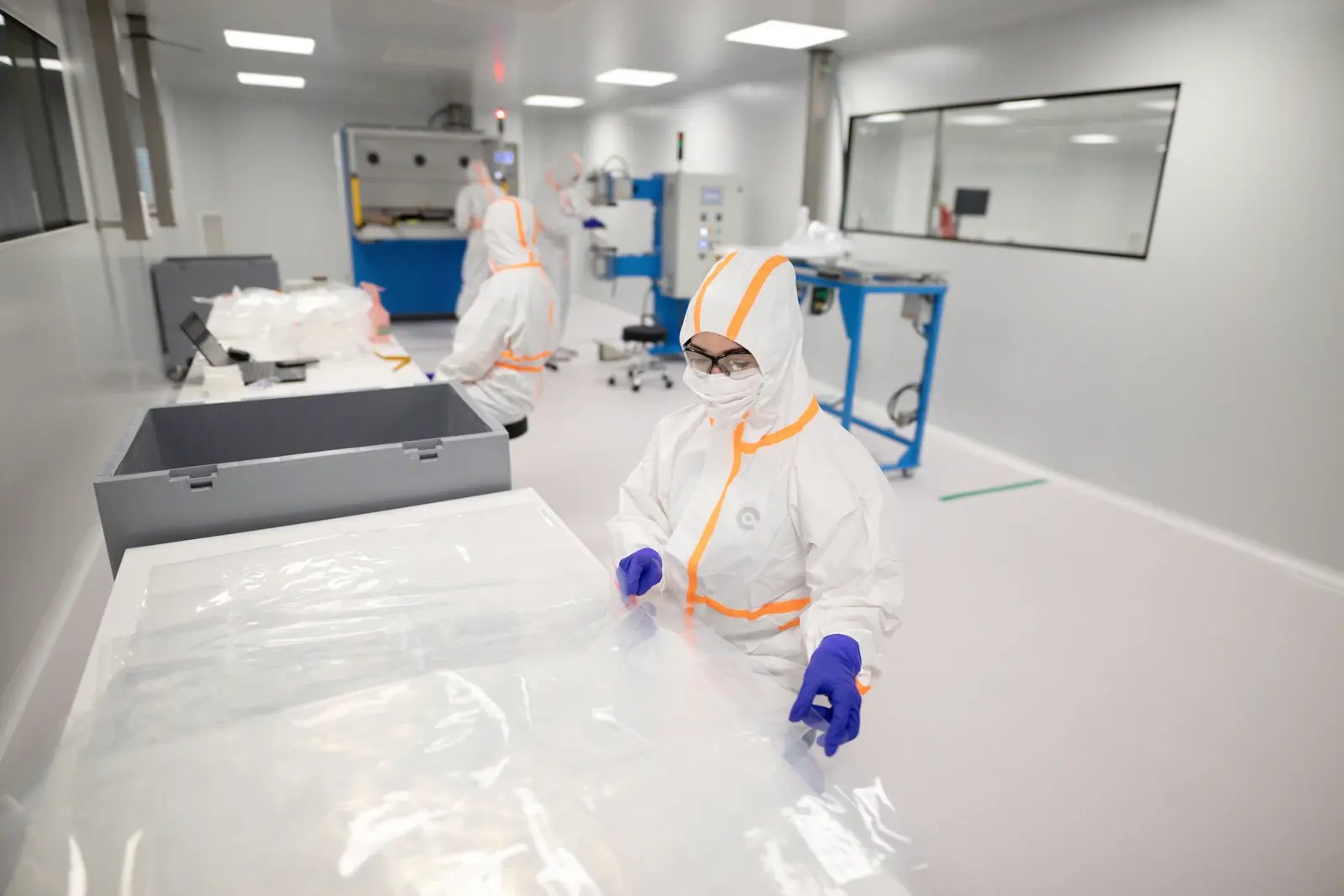
In grade B, Annex 1 calls for a hood, a facemask and goggles that cover the whole face (point 7.13). In the photos, you can barely recognise anyone. That helps when the customer's staff must not appear, but it will not show your own people or put a face to your service team.
Before shooting, look at everything around the equipment. Customer logos, product or batch labels, control screens showing process data, whiteboards and other suppliers' systems. Any of these can reveal information the customer wants to protect. Every shot needs the customer's approval before it goes on the website, into the catalogue or onto a trade show stand.
Can a photographer go into a grade A or B area?
Only if the site allows it and organises it. EU GMP Annex 1 (point 7.5) says unqualified personnel should not enter grade B or grade A in operation, and that exceptional cases need a written procedure and supervision. So ask the customer early on and keep a fallback plan based on renders.
When a render is the better option
A render covers the cases where a photo is impossible or not worth the effort. The system is not installed yet, the facility belongs to a customer who does not want it seen, or you need the same clean room across the whole range. The equipment goes into a generic cleanroom, with whatever light and angle you need, and nobody has to gown up.
It can also show things a real room cannot. For example, the system connected to the rest of the line, each grade zone marked in colour, or the path material takes through the airlock. The condition is that engineering validates the scene and the caption makes clear it is an illustration.
Not sure your customer's site will let you take photos? Leave your details and we will tell you which images you can still get.
Send me a proposalWhen you need real photography
A photo is proof that the equipment exists and works in a real facility. It carries weight wherever buyers look for trust, such as the company page, a case study the customer has approved or news of an installation. However good a render is, it cannot prove any of that.
You do not need to get into the customer's cleanroom to have real photos. You can shoot in your own workshop, in the test area during FAT or in your own cleanroom if you have one. You can also ask the customer whether photos are possible before the room goes into production, for example during SAT.
Can we publish photos of equipment installed at a customer site?
Only with written permission and after the customer has reviewed every image. You can propose a shot that shows nothing of their process, brand or facility. Without permission, a photo in your workshop before shipping or a render in a generic room does the same job.
Photography or render, criterion by criterion
The table sums up what usually tips the decision. Cost has no figures because it depends on too many things. For example, whether a 3D model already exists, how many views you need or how many hours of site time and customer staff a photo shoot takes.
| Criterion | Photography in the cleanroom | 3D render |
|---|---|---|
| Access | Site permission, qualified or supervised staff and cleaned or disinfected kit. | No site access needed. |
| Confidentiality | Every shot goes through customer approval. | Generic room, nothing from the customer. |
| Credibility | Proves the equipment exists and runs. | Illustrates, but does not prove. |
| Flexibility | Depends on light, space and the site's schedule. | Any angle, cutaways and equipment variants. |
| Cost and time | Photographer, site and customer staff hours, with a risk of reshoots. | Depends on whether a 3D model exists and how many views you need. |
| Works best on | Company page, case studies and news. | Catalogue, product pages, proposals and trade shows. |
Can a cleanroom render look fake?
It can if the room is too perfect or details do not add up, such as doors without an airlock, surfaces that could not be cleaned or people without the right gowning for the grade. Have someone from quality or engineering review the whole scene, not just the equipment, because buyers in this sector spot it straight away.
How to mix photos and renders without a visible jump
Plan both at the same time. If the photo shoot and the renders use similar angles and lighting, the catalogue looks consistent even when it mixes the two. Start with the list of images you need and decide, one by one, whether each will be a photo or a render.
Every caption should say what the image is. A render, a photo in your workshop or a real installation shown with the customer's permission. In a sector where quality reviews everything, that clarity avoids awkward questions in an audit or in a meeting with the buyer.
