

On this page
How many Horizon Europe projects work on bioprocessing
158 Horizon Europe projects mention bioprocessing or bioreactors in their title, summary or keywords. CORDIS lists 135 as signed, 13 as closed and 10 as ended early. 89 mention bioreactors and 78 mention bioprocessing, with some overlap. Only 24 have the term in the title.
By signature year there are 42 from 2022, 31 from 2023, 30 from 2024, 25 from 2025 and 30 from 2026 up to 5 October. The maximum EU contribution adds up to 407.0 million euros. That money pays for research and does not say what will be bought. It does show where groups are working with bioreactors.
- 53 are Marie Skłodowska-Curie fellowships and training networks.
- 40 come from the EIC, the European Innovation Council, and 22 of those from the EIC Accelerator for startups and SMEs.
- 26 come from the ERC, which funds frontier research.
- 39 are research, innovation or coordination projects (RIA, IA and CSA).
Which countries have the most bioprocess projects
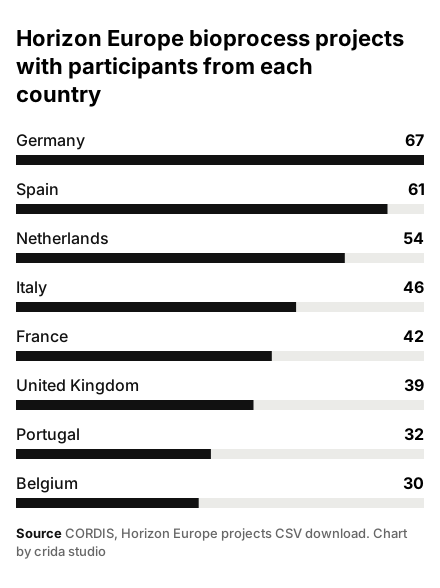
Germany appears in the most projects, 67 of 158, followed by Spain with 61. Next come the Netherlands with 54, Italy with 46, France with 42 and the United Kingdom with 39. A project counts in every country where it has a participant, so the total is higher than 158.
Spain coordinates more projects than any other country, 29 of 158, ahead of Germany with 27 and the Netherlands with 17. It also has the most participations, 135 against 123 for Germany. In funding terms, German participants are allocated 66.6 million euros of EU funding and Spanish participants 55.8 million.
| Country | Projects |
|---|---|
| Germany | 67 |
| Spain | 61 |
| Netherlands | 54 |
| Italy | 46 |
| France | 42 |
| United Kingdom | 39 |
| Portugal | 32 |
| Belgium | 30 |
What is CORDIS and who can use it?
CORDIS is the European Commission service that publishes EU-funded research projects, with each project's summary, participants and funding. Anyone can search it online or download the data as CSV files. That is why this count can be repeated and compared a few months from now using the same filter.
What kind of organisations take part
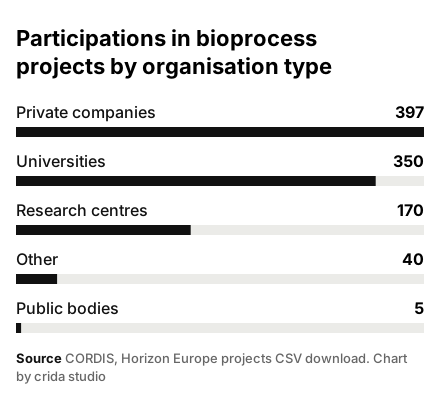
Private companies are the largest group, with 397 of the 962 participations. Universities account for 350 and research centres for 170. 291 participations are SMEs, and 101 of the 158 projects include at least one private company. Each participation is one organisation in one project, associated partners included.
Coordination usually sits with a university. Universities coordinate 92 projects, companies 35 and research centres 28. Our reading is that an equipment supplier should usually start with the group running the project, even when companies are in the consortium.
| Organisation type | Participations |
|---|---|
| Private companies | 397 |
| Universities | 350 |
| Research centres | 170 |
| Other | 40 |
| Public bodies | 5 |
Want us to check which projects and organisations on this list fit what you sell? Leave your details and we will tell you where we would start.
Review the projectsWhich applications go beyond pharma
Bioprocessing in these projects reaches well beyond medicines. We did not count by category, but reading the titles shows five broad application areas. In our view, each area needs its own vocabulary, messages and trade shows.
A few example titles are PAT4CGT, on automated monitoring and control in cell and gene therapy, MultiSpek, a multi-sensing platform for single-use applications, ComfyCell, a bioreactor for stem and immune cell manufacturing, and AIR2FOOD, a European hub for gas precision fermentation.
- Cell therapy and regenerative medicine, including iPSC, CAR-T, blood, bone marrow and tissue.
- Precision fermentation and food, including proteins, mycelium and cell-based milk.
- Bioeconomy and chemicals, including biorefineries, CO2, biofuels and bioplastics.
- Wastewater and the environment.
- Sensors and process monitoring, including PAT and single-use sensors.
Does a Horizon Europe project buy bioprocess equipment?
Not always, and the data does not say. The EU contribution covers research costs, which can include equipment, staff or services. What a project does tell you is that a team will be working with bioreactors or bioprocessing for a few years. So we use it to prioritise accounts and plan content, not to forecast sales.
What equipment marketing teams can take from this
The count does not tell you who will buy. It does give you a public list of groups, companies and applications already working with bioreactors. With that list, the marketing team of a bioprocess equipment maker or supplier can work on four concrete things.
Spain and Catalonia are a nearby market for a supplier based here. There are 135 Spanish participations in 61 projects, 54 from companies, 39 from universities and 37 from research centres. Catalonia has 29 in 21 projects and the Madrid region 42. These are accounts you can visit without long trips.
- An account map of universities and startups. The 350 university participations and the 22 EIC Accelerator projects are two audiences that, in our view, need different messages.
- Application segments outside pharma, such as food, bioeconomy or environment, each with its own messages and events.
- Consortium partners. A manufacturer can join a proposal by bringing equipment and scale-up, and current coordinators are a sensible place to start.
- Content and campaigns by application, with separate application notes, case studies and ads for cell therapy, precision fermentation or wastewater.
How to repeat the count and turn it into an account list
You can repeat the count without writing code. In the CORDIS project search, filter by the Horizon Europe programme and search for bioreactor or bioprocess. The CSV download lets you go further and join projects and organisations in a spreadsheet by country, organisation type and application.
At crida studio we do this work as part of strategy and market research for the biotech sector. We turn public data like this into a list of accounts, segments and messages your sales team can use. We do not promise results, because they depend on each product and each market.
How can an equipment maker join a European consortium?
Usually by talking to groups already preparing proposals, which are often universities or research centres. A company can bring equipment, scale-up or industrial validation. CORDIS shows who coordinates projects in each application and country. A web page that explains what your company brings to a consortium also helps.
How we counted and where the limits are
We downloaded the CORDIS CSV file of Horizon Europe projects on 5 November 2026, with files dated 5 October 2026. Using python3, we counted projects with a word starting with bioprocess or bioreactor in the title, summary or keywords. A project that uses bioreactors without naming them is missed, and some that only mention them in passing are included. The United Kingdom takes part as an associated country, and 2026 is not complete.
Each participation is one row in the organisations file, meaning one organisation in one project, including associated partners and third parties. The country is the one in each organisation's address. Amounts are the EU contribution recorded in CORDIS, which does not mean it has already been paid.
