

On this page
With single-use consumables, the business is the reorder
A single-use bag, filter or connector is used once and bought again. What matters is the same customer ordering the same part number year after year. The first sale gets you in the door, but the revenue comes from the orders that follow it.
A listed company in the sector shows it clearly. In its preliminary 2025 results, published on 3 February 2026, Sartorius reported 2,865 million euros in sales for its Bioprocess Solutions division. A large majority came from recurring business with consumables such as filters and single-use bags. Equipment sales fell as customers held back on investment.
For 2026, the same release expects the division's growth to come mainly from consumables. If you sell consumables, landing a customer is where the real work starts, which is serving them well enough that they never go looking for another supplier.
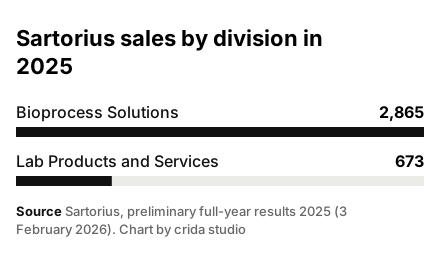
| Division | Million euros |
|---|---|
| Bioprocess Solutions | 2,865 |
| Lab Products and Services | 673 |
Why switching suppliers is hard for the customer
Customers validate a consumable inside their process, and once it is validated, replacing it means opening a change control. Annex 1 of the EU GMP guidelines, which covers the manufacture of sterile medicinal products, says in point 8.134 that assessing suppliers of single-use systems is critical to selecting and using them.
Point 8.136 asks for the extractable and leachable profiles to be evaluated, with an assessment for each component. Point 8.138 asks for the documents that come with each delivery, such as the certificate of conformance and proof of sterilisation, to be reviewed on receipt. All of that takes the customer time, so a happy customer would rather leave things alone.
Do we need a customer portal, or is email enough?
It depends on how many customers and part numbers you have. With a small customer base, a well-built reorder email and a folder of certificates by lot may be enough. As part numbers and lots grow, a customer area with orders, certificates and repeat ordering saves work on both sides and cuts the emails asking for paperwork.
Change notification is marketing too
A badly handled change notice is the moment a customer starts thinking about leaving. Change is part of life with single-use systems, and the customer has to decide whether to accept each one. BioPhorum, where biomanufacturers and suppliers work together, published a guide in 2020 on the information that should come with these notices.
The guide aims for all the information to arrive in one place at the right time, so the customer can make an informed decision. In 2022 BioPhorum released a template for these notices. The template page says notifications have risen sharply since the start of the pandemic, and that one member went from receiving two a week to 200 a month.
The same page names incomplete data and non-standard formats as problems. A notice that arrives complete, in the same format every time and with a named contact avoids both. Publish your change notification policy on your website and explain how people can sign up to receive notices.
Want us to look at how you tell customers about changes and reorders today? Leave your details and we will tell you what we would automate first.
Review my noticesWhat documents customers should find on your website
A customer validating a consumable looks for paperwork before prices. If they find it without emailing anyone, your website has saved them work. If it takes three emails to get a certificate, they will remember it the day someone offers them an alternative.
Public information belongs on each product page. Anything lot-specific or confidential goes in a customer area behind a login. Use exactly the same part number on the website, on the delivery note and on the certificate.
- Certificate of conformance and proof of sterilisation, downloadable by lot number.
- A summary of the extractables and leachables studies and how to request the full report.
- Change notification policy, with the change categories and a contact.
- Supply information, such as where it is made, usual lead times and who tells customers about delays.
Can we publish extractables and leachables studies on our website?
You can publish a summary and explain how to request the full report. Many manufacturers share it inside a customer area or under a confidentiality agreement. EU GMP Annex 1 asks customers to evaluate these profiles for each component, so the easier you make access, the easier it is for them to validate your product.
How to automate reorders and customer notices
Consumable reorders follow the customer's production schedule, and you can read that schedule in the order history. With that history in your CRM you know how often each customer orders each part number, so you can send a reorder email before they run short. The email shows the part number, the last quantity and a button to repeat the order.
The same data drives your notices. If you store the part numbers each customer buys, a change or delay notice reaches only the people it affects, with the documents attached. Customers who do not buy that part get no noise and keep opening your emails.
- A reorder email timed to each customer's ordering pattern for each part number.
- Change and supply notices segmented by part number.
- A customer area with past orders, certificates by lot and a repeat order button.
Who should receive change notices at the customer?
Usually quality, purchasing and the process person who validated the consumable. Store who is who in your CRM for each customer and part number. The 2020 BioPhorum guide aims for all the information to arrive in one place and on time, and that only happens if you know who to send it to.
Where to start if you make or distribute consumables
Start by looking at which customers buy each part number and how often. Then sort out the documents you are asked for most and put them on the product page or in the customer area. The last step is connecting your CRM to email so notices and reorder reminders go out on their own.
Distributors need the same, built on the manufacturer's documents. Agree with the manufacturer how change notices reach you and how much notice you get, so your customers never hear about a change from someone else first.
David Monje, founder of crida studio, led marketing at TECNIC for four and a half years. TECNIC makes bioreactors, TFF systems and single-use consumables, and there David built B2B funnels with SEO, SEM and automation. This kind of web, CRM and automation work is what we do at crida studio.
