

On this page
When should a brand be redesigned?
A redesign is worth considering when an identity no longer represents the offer, appears inconsistently or cannot support the applications the business needs. Before changing the logo, identify which of those problems needs solving, because each calls for different work.
Asking only whether someone likes a design can overlook the business problem. It is more useful to observe what they understand when they see the brand and what is missing. Try it with three or four customers and someone from outside.
Recognise what should be retained
A name, visual features or a way of explaining the offer may have value because customers already recognise them. Assess that recognition before replacing them. Changing a name or a symbol means explaining who you are all over again to people who already knew.
- Elements people identify without help.
- Applications that work with real content.
- Differences between what is said and what is shown.
- New uses the current identity does not handle well.
Is evolving an identity always better than starting again?
It depends on the value of the existing elements and the kind of problem. Review recognition, applications and business direction before deciding. If everyone identifies the name and the sign, evolving is usually the way. If the identity confuses people, starting again may be more honest.
Test the identity where it will be used
A visual proposal should be assessed using the applications the business needs. A homepage, service page and everyday document can test different requirements. A product label, a shop sign and a phone icon add other requirements.
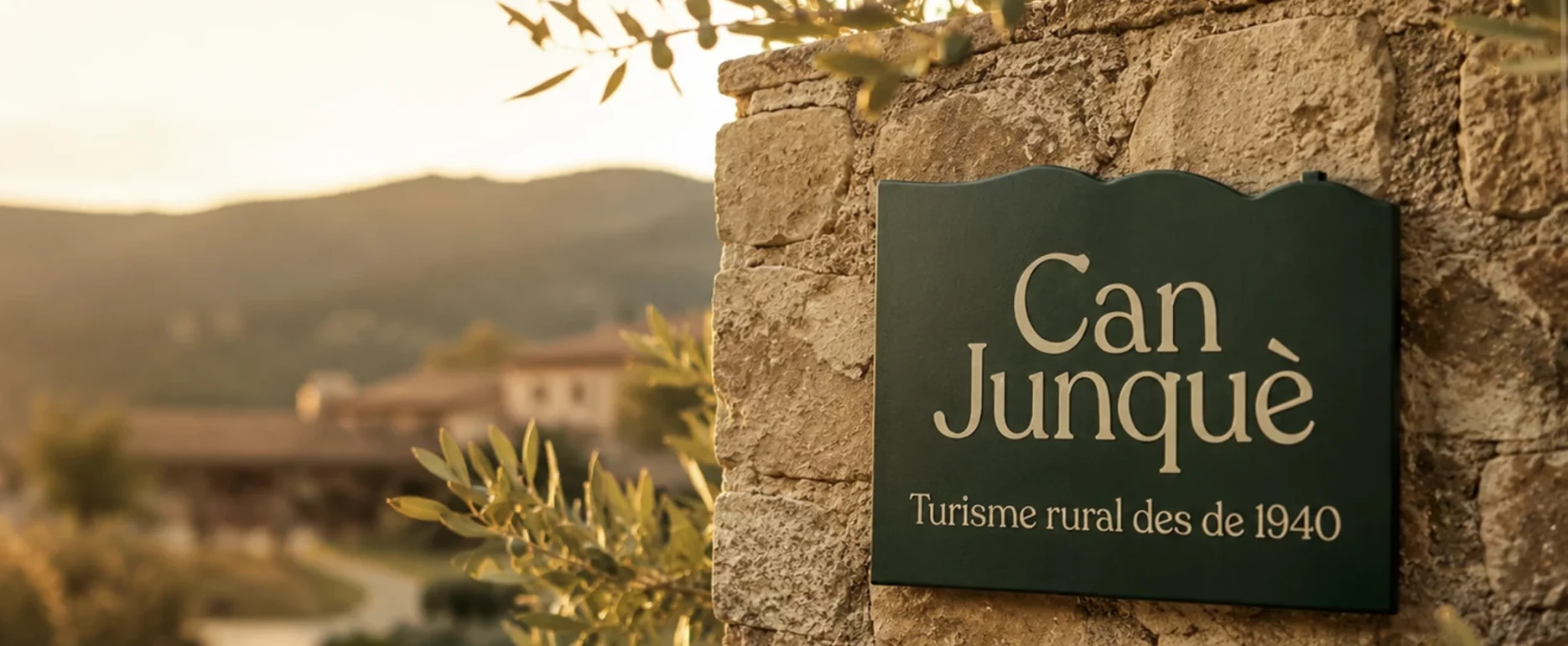
At Can Junqué, identity, photography and the website are part of one project, from the sign to the web pages. The case helps show how these pieces relate without assuming every brand needs the same set of applications.
On screen, colour has to be readable. WCAG 2.2 from the W3C requires a minimum contrast of 4.5 to 1 between normal text and its background, and 3 to 1 for large text and interface elements, under criteria 1.4.3 and 1.4.11.
Want us to look at your case? Leave us your details and we’ll tell you where we would start.
Let's talkPrepare a commission that can be compared
Explain why change is being considered, who the brand addresses, which materials are needed, in which languages, and who will approve decisions. Proposals can only be compared properly when their scope is similar and their assumptions are stated.
The final question is what the brand should be better able to do after the work. That answer is more useful than a list of trends. If the answer is to look more modern, there is still work to do. If it is to explain a new service, work can begin.
Do I have to change the name if I redesign the brand?
Not necessarily. The name is usually the element with the most recognition and the hardest to replace. Changing it only makes sense if it causes confusion, cannot be registered or the business has changed so much that it no longer fits.
Four steps to review the brand before deciding
This review can be done in a few sessions with the people who deal with customers every day. The aim is to reach the decision with real examples in hand. Opinions about the logo can come later.
- Step 1. Gather everything that carries the brand, from the shop sign to the email signature, and look at it together.
- Step 2. Ask customers and someone from outside what they understand and what is missing.
- Step 3. Sort the problems into messaging, application and identity, and decide what to keep, adjust or change.
- Step 4. Check whether the name can be registered and list the materials that will be needed.
An example. A Girona pastry shop opening a second store
This example is made up. A long-established pastry shop in Girona opens a second store and starts taking orders online. The owner wants a new logo because hers looks old to her. Before drawing anything, it is worth looking at the brand everywhere it appears.
The review shows that everyone in the neighbourhood recognises the name and the shop sign. The symbol is unreadable at small sizes on a phone, boxes and bags carry different versions of the logo, and the website does not mention orders for celebrations.
The decision is to keep the name and the character of the sign, adjust the symbol so it works small, fix a single version for packaging and social media, and write the website so it explains the orders. Long-standing customers still recognise the shop.
How do I know whether the problem is the logo or the message?
Test it with someone who does not know the company. If they understand what you do but dislike how it looks, it is identity. If they do not understand what you do, it is messaging. If they understand it on the website but not on a label, it is application.
How to choose between adjusting, evolving or starting again
The three options make sense in different situations. Deciding before asking for proposals avoids comparing a logo touch-up with a new identity as if they were the same commission. These criteria help place each case.
If the change affects the name, check first whether it can be registered. In Spain, ownership of a trademark is acquired by registration, under article 2 of Trade Marks Law 17/2001. The register is kept by the OEPM, under article 1, which offers a trademark locator for a first check.
In Catalonia, think about language as well. Article 128-1 of the Catalan Consumer Code gives consumers the right to receive fixed information, quotes and invoices in Catalan. Plan for this when you design the shop sign and the stationery.
- Adjust when recognition is high and the problems are about application, such as sizes, versions or new formats.
- Evolve when the name and some features have value but the message or the offer has changed.
- Start again when the identity does not represent the business, causes confusion or cannot be registered.
