
On this page
What Verifactu is and what it asks of your invoicing software
Verifactu is shorthand for the regulation approved by Royal Decree 1007/2023, as the Spanish tax agency (AEAT) explains in its own FAQ. The regulation does not change what an invoice looks like. It sets requirements for the software that produces it, which the rule calls an invoicing computer system.
Article 8 requires the software to guarantee the integrity, preservation, accessibility, legibility, traceability and unalterability of invoicing records. Every invoice produces a record with a hash, chained to the previous one, that cannot be deleted or edited without the software detecting it. The software must be able to send those records to the tax agency (article 8.1). Each invoice carries a QR code, under the first final provision of the decree, which adds it to the invoicing regulation.
Who it applies to and who is left out
Article 3.1 covers companies paying Spanish corporate tax and self-employed people with a business activity, among others, as long as they use software to invoice, even for only part of their activity. A restaurant in Girona with a POS, a clinic with practice software or a property developer invoicing from an ERP all fall inside.
Article 3.3 leaves out taxpayers who keep their VAT ledgers through the AEAT online office, the system known as SII. The AEAT sums it up as the rule of four noes. It does not apply to anyone who invoices entirely by hand, anyone on the SII, anyone whose tax domicile is in the Basque Country or Navarre, or anyone with a non-application ruling.

I make my invoices in Excel or Word. Does Verifactu apply to me?
It depends on what you do with them. According to the AEAT FAQ, if Excel or Word are used only to enter the data, issue and print the invoices and keep them, the regulation does not apply. If you also use them to generate your VAT ledgers or your accounts, for example with a macro, they count as an invoicing computer system. Check with your accountant.
When it becomes mandatory. What the law says and what the Treasury has announced
The fourth final provision of Royal Decree 1007/2023, as worded by Royal Decree-Law 15/2025, says corporate taxpayers must have their software adapted before 1 January 2027 and all other obliged taxpayers before 1 July 2027. As of 31 October 2026, that is the text published in the Spanish official gazette, the BOE.
On 5 October 2026 the Ministry of Finance published a note saying it plans to postpone the pending obligations of the regulation to October 2028, so they coincide with mandatory electronic invoicing for anyone invoicing up to 8 million euros a year. The note says the technical requirements will remain substantially equivalent.
Until that postponement appears in the BOE, the 2027 dates are the ones that count. The AEAT describes the period before them as a testing period. You can send test records with Verifactu software and keep invoicing with another program until the deadline.
If the Treasury postpones it to 2028, can I wait?
The Treasury note of 5 October 2026 is a forecast and has not yet changed the BOE. Until it is published, the legal date is 2027. The same note says the technical requirements will remain. Whatever you do now to adapt your software is useful whether or not the postponement goes ahead.
Want us to look at your case? Leave us your details and we’ll tell you where we would start.
Let's talkTwo ways to comply. Send records to the AEAT or keep them signed
The regulation allows two kinds of software. The first sends every invoicing record to the tax agency continuously and automatically. Article 16 calls it a verifiable invoice issuing system, or Verifactu system. It is presumed to meet article 8 and does not need to sign each record electronically. Calculating the hash is enough.
The second kind sends nothing to the AEAT. In that case the software must electronically sign every creation and cancellation record (article 12). Both kinds must have a secure download and archiving procedure for the records (article 8.2.c). Invoices issued with a Verifactu system carry the phrase «Factura verificable en la sede electrónica de la AEAT» or «VERI*FACTU». If you start sending records systematically, you are deemed to have chosen Verifactu (article 16.5).
What to ask your software vendor this quarter
The software producer must certify with a responsible declaration that the product meets the regulation (article 13). It has to appear in writing and visibly inside the software, in every version, and you are entitled to ask for it. If your vendor cannot show it to you, you have a problem. These are the questions to ask now.
The AEAT recommends asking the vendor first whether an adapted version exists, and otherwise considering another program, its own free invoicing application or an in-house development. The AEAT application is option b of article 7 and counts as a Verifactu system (article 16.4).
- Do you have the responsible declaration for the version I use? Can you send it to me?
- Is the adapted version available yet, or when will it be? Do I need to update or switch programs?
- Does it work in Verifactu mode, sending records to the AEAT, or does it only keep signed records?
- How do I export every invoicing record if I change software or the tax agency asks for them?
Do I need to change software or is an update enough?
It depends on the vendor. The AEAT recommends asking them first whether an adapted version exists, as that is the most common case. If there is none, the options it lists are another adapted program, its own free application or an in-house development. In every case, ask for the article 13 responsible declaration before paying.
What happens to the old software and what the penalty is
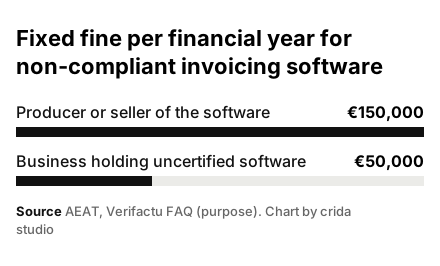
Article 201 bis.2 of the Spanish General Tax Law, quoted in the AEAT FAQ, penalises holding invoicing software that is not certified when it should be, with a fixed fine of 50,000 euros per financial year. The same answer lets you keep the old program to look up past invoices if you can show it can no longer issue them. If after the deadline it can still invoice, the AEAT says merely holding it would be an infringement.
For a small business this is a good moment to tidy up the whole process. If quotes come out of one tool, invoices out of another and payments out of a third, adapting to Verifactu is the excuse to connect them. That is how we approach it when we automate processes.
| Who is in breach | Fine per financial year |
|---|---|
| Producer or seller of the software | €150,000 |
| Business holding uncertified software | €50,000 |
