

On this page
Which task is a good first candidate?
Start with an operation you can describe from beginning to end. Moving an enquiry into a CRM, preparing a quotation draft or collecting reporting data may be candidates when they repeat and their inputs are recognisable. A frustrating task is not automatically ready for automation. You still need to understand the decisions inside it.
Over a representative period, record who does the work, what information they need, how long it takes and what goes wrong. Include difficult cases. If the team interprets each request differently, the first job is to agree the process. Connecting applications before resolving that difference usually moves the confusion between systems rather than removing its cause.
Can we start without replacing our ERP or CRM?
Possibly, if the system provides the access the workflow needs. Check its connections, permissions and terms first. Having an API does not by itself resolve the implementation.
What might this look like for a manufacturing business?
Imagine a manufacturer in la Selva receiving catalogue requests through its website. This is an illustrative approach, not a crida studio project or a reported result. A workflow could check the fields, look for an existing company in the CRM and prepare a sales task containing the requested product and the language used by the enquirer.
If a product reference is missing or two contacts might match, the workflow should request a review. The initial goal can be to organise information without sending a quotation or promising availability. Separating preparation from sending makes the process easier to test with limited consequences. The sales owner first needs to agree what counts as a valid contact and who follows up.
Can an automation send quotations directly?
A workflow can be designed that way, but preparation and approval should be separate decisions. Commercial conditions and exceptions need clear rules and an accountable owner.
Does this workflow actually need AI?
Not when the decision can be expressed through clear rules. Checking for a code, moving a file or flagging a missing field does not require language interpretation. A connection between systems may provide a simpler, more testable solution. Reserving AI for the part that needs interpretation avoids introducing uncertainty into the entire process.
AI may help classify a free-text enquiry or prepare a summary. That requires agreed sources, boundaries on the information it can use and a way to review the output. A convincing answer can still contain an error. Our approach at crida studio separates writing a proposal from authorising its delivery, even when both actions belong to the same commercial journey.
Does every automation need an AI subscription?
No. Many tasks need rules and application connections. Add AI where interpretation has a defined purpose and its output can be reviewed.
Want us to look at your case? Leave us your details and we’ll tell you where we would start.
Let's talkWhat should you check in n8n, Make or Zapier?
Compare the connection you actually need and who will maintain it. An extensive integration catalogue does not confirm that a connector supports your specific action, fields or permissions. Test a representative example, including incomplete data. Then review limits, execution records, responsibilities and the provider’s current terms before committing to a configuration.
n8n’s official documentation covers hosting on your own infrastructure and the associated management work. Make documents scenario error handling. Zapier provides human review steps that can pause a workflow. These differences help frame your evaluation. They do not make one tool universally better. The account access, plan and implementation still need to be checked for your situation.
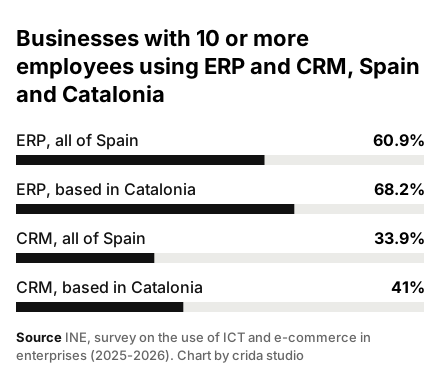
Before choosing a tool, check which systems you already have, since according to Spain’s INE, 60.9% of businesses with 10 or more employees and internet access used an ERP and 33.9% a CRM in the first quarter of 2026.
Among businesses with 10 or more employees headquartered in Catalonia the share is higher, with 68.2% using an ERP and 41.0% a CRM, according to the same 2026 INE data.
- Who can access the data and change a connection.
- How a failure is detected and what the owner is told.
- What happens when a password, field or application changes.
| Software and area | Share of businesses |
|---|---|
| ERP, all of Spain | 60.9% |
| ERP, based in Catalonia | 68.2% |
| CRM, all of Spain | 33.9% |
| CRM, based in Catalonia | 41% |
What happens when work fails or runs twice?
The design should distinguish a new input from a repeated one and leave a clear signal when it cannot continue. Retrying without checking the current state can duplicate a record, a task or a message. Agree a reference that identifies work already completed and which actions are safe to repeat without creating another effect.
Test empty fields, duplicate contacts, an unavailable service and an interrupted execution. Write down the expected outcome for each situation. The owner should know where to look and how to recover unfinished work. A process that only its original builder understands will be difficult to operate when that person is unavailable or the team changes.
How do you compare cost with work actually saved?
Separate initial setup from software subscriptions, hosting, service usage and ongoing maintenance. The cost does not end when two applications connect. Reviewing changes, resolving incidents and checking that the information is still correct also take work. A platform name alone cannot establish the price of a business automation or its likely return.
Compare the same kinds of operation over equivalent periods. Measure the full effort, including reviews and corrections. Time spent preparing a system output is not automatically time saved by the business. Better follow-up or fewer missing details may also be useful outcomes, but decide how you will observe them before claiming that they have improved.
What should be ready before you switch it on?
Start with a limited scope and a way back to the manual process. Document account ownership, connections, rules, alerts and the person approving changes. Manage credentials through appropriate secure channels rather than a shared instruction document. Agree which test data should be removed and how the team will identify live work during the transition.
At crida studio, we consider automation alongside the sales journey and the systems a business already uses. The initial conversation can begin with a specific task and representative material that contains no sensitive data. From there, we can define a test, its limits and a proposal. A useful commitment is a verifiable acceptance criterion, not a promise that everything will run by itself.
Do you work with businesses outside Girona?
crida studio works from Caldes de Malavella with businesses across Girona, Catalunya and Spain, as well as remote clients. Meetings, test scope and maintenance are agreed for each project.
