
Astroletra. Design and development of a sky almanac with an API and open data
Astroletra is a daily horoscope and sky almanac in Spanish, for Spain and Latin America. We designed and built it from start to finish. It calculates the sky with the JPL DE440 ephemerides and opens its data through a free API and a DOI.
What this project is about
Astroletra publishes the horoscope of the twelve signs every day, along with a sky almanac in Spanish, written for readers in Spain and Latin America. Next to every reading sits the data, the time of the Moon, the eclipses and the planets, calculated and set to the time of each city.
We took care of all of it, from the brand and the design to the calculation engine, the API, the open data and the SEO. The calculations come from the JPL DE440 ephemerides, from NASA’s Jet Propulsion Laboratory, and the data is open, with a free API and a DOI so anyone can cite it and check it.
Here we explain how we solved the pieces that took the most work, the calculations, the eclipse town by town and the open data. It is the kind of project we enjoy, a website where every figure can be checked.
The project
- Website
- astroletra.com
- Open data
- DOI 10.5281/zenodo.24132871
- Public API
- API documentation
- Eclipse by town
- The finder for all 8,132 towns
- Market
- Spain and Latin America
- Services
- Web design and development, branding, SEO, open data, and public API
- Website language
- Spanish
- Status
- Online
How it started
Astroletra had to work both for reading the horoscope every day and for knowing when each thing really happens in the sky. It wanted to reach readers in Spain and Latin America, and the data always had to be checkable. We started it in November.
What we decided
The Astroletra brand
We also made the brand. The logo is a tile that fades from Prussian blue to night blue, with a paper A and a ring of light around it, like a planet’s. Beside it sits the name, set in Ibarra Real Nova, a typeface with the air of a newspaper masthead.
Everything else follows the same tone, the paper and ink of a newspaper, Prussian blue and an ochre, and a colour of its own for each sign. We wanted Astroletra to look like a well-made newspaper, not like every other horoscope website.
The logo comes in versions for light and dark backgrounds, and the tile on its own is the icon on phones and in the browser tab.
- Paper
- Ink
- Prussian blue
- Ochre
The Astroletra logo for dark backgrounds and the four colours of the brand. Design by crida studio. The data and the reading, each in its place
On the home page, the data and the reading are kept apart. On one side is today’s sky, with the Moon, its rise and set and the time of each moment in the reader’s city. On the other, the twelve signs to pick your own.
That way anyone who comes in knows what is calculation and what is interpretation, and can change the city so every time adjusts to it.
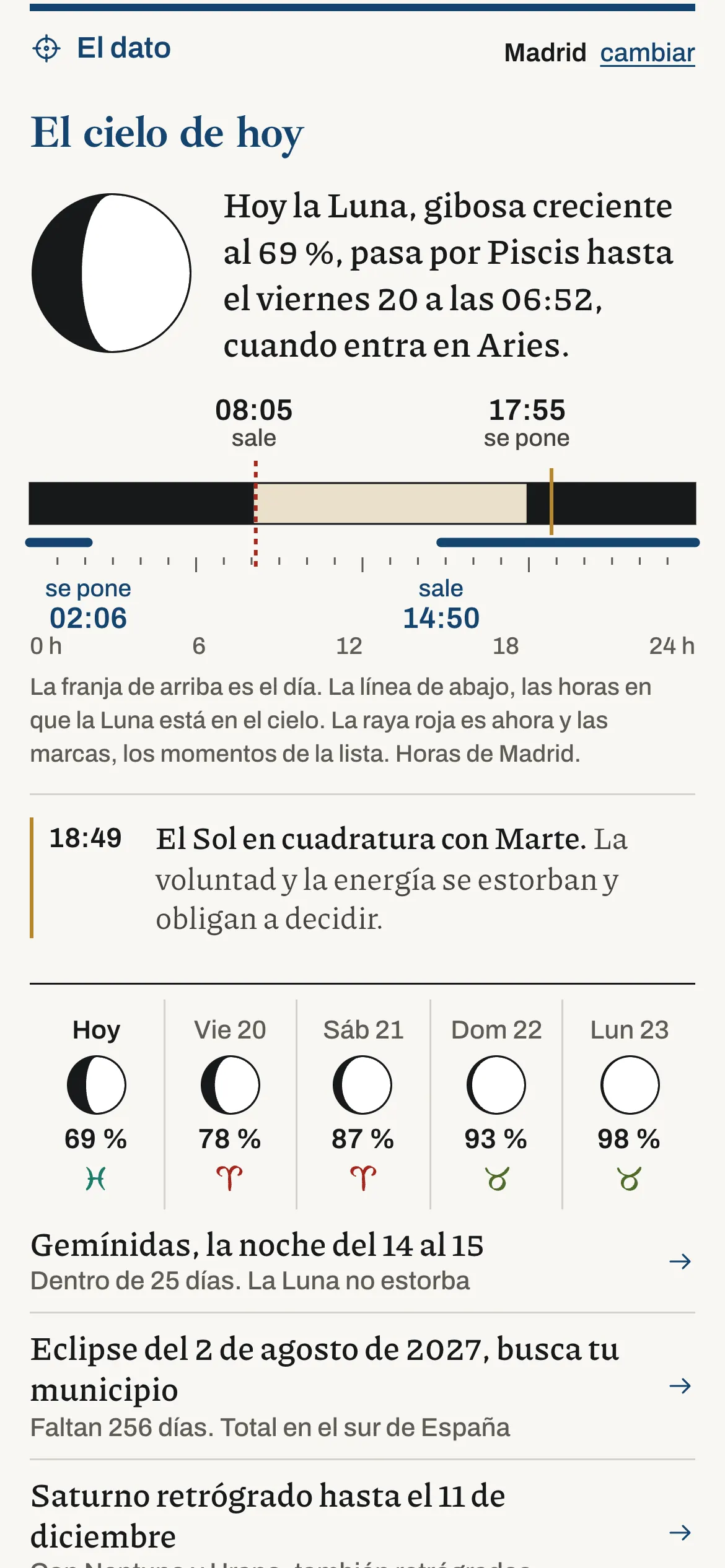
Today’s sky on the Astroletra home page, on a phone, on 19 November 2026. Screenshot by crida studio. Every time, calculated with the JPL DE440 ephemerides
The times of the Moon, the eclipses, the retrograde planets and the Sun’s entry into each sign are not copied from anywhere. They come from the engine we built, with the JPL DE440 ephemerides from NASA’s Jet Propulsion Laboratory, and are then converted to the time of each place.
The data gives the local time in eight cities, Madrid, London, New York, Los Angeles, Mexico City, Bogotá, Santiago and Buenos Aires, and the website gives the time of each moon in Spain, Mexico, Colombia, Peru, Argentina and Chile.
The pages of the website, the API and the open files all come from the same data, so they always say the same thing.
- JPL DE440 ephemeridesWhere the Moon, the Sun and the planets are at every moment.
- The calculationThe phases, the eclipses, the retrogrades and the Sun’s entries, with their times.
- The time of each placeEvery moment converted to the time zone of each city.
A single sourceThe pages, the API and the open files come from the same data.How every time shown on Astroletra is calculated. The total eclipse in August, town by town
For the total solar eclipse of 2 August we built a finder with all 8,132 municipalities in Spain, using data from the National Statistics Institute. Anyone types their town, or uses their location, and sees when it starts, when it is total, how long it lasts and when it ends.
Totality will be seen in 104 municipalities, plus Ceuta and Melilla. A map shows the band where it will be total, a list ranks the towns by duration and each province has its own page. The location is used on the phone itself and never leaves it.
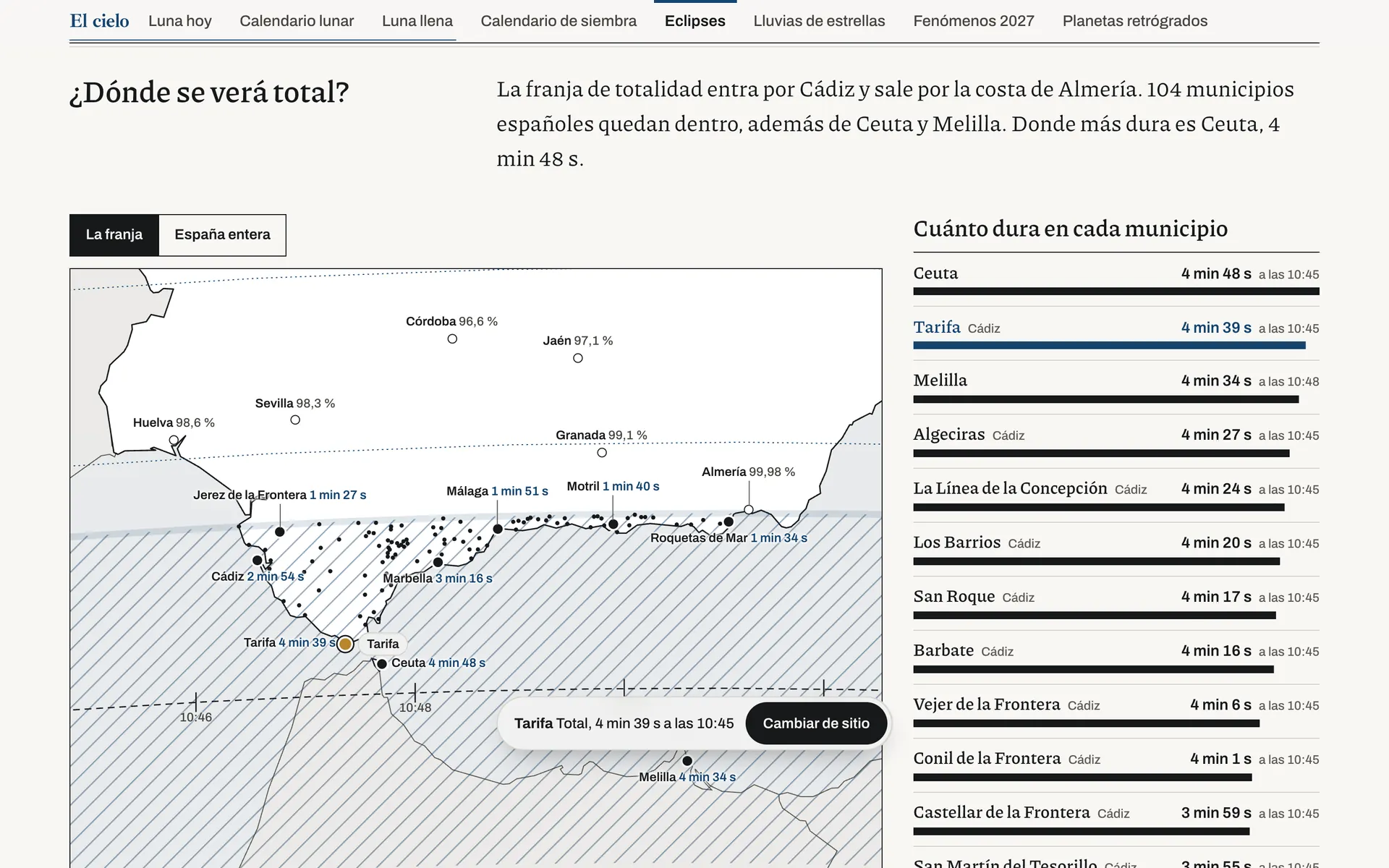
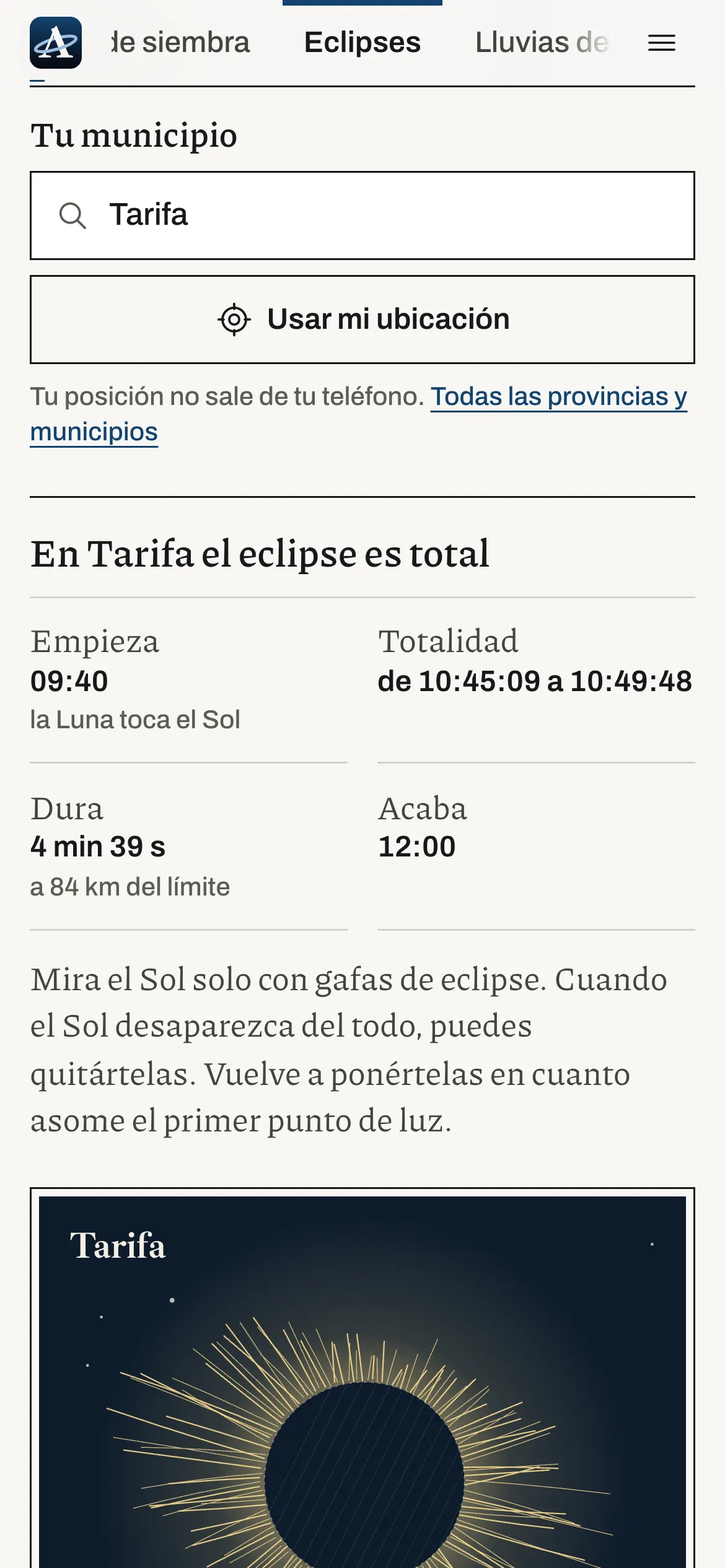
The page of the eclipse of 2 August 2027, with the map of the band on a computer and Tarifa chosen on a phone, on 19 November 2026. Screenshots by crida studio. Open data with a DOI and a free API
The calculated data can be downloaded as CSV, JSON and iCal files, under a CC BY 4.0 licence. It covers three years of sky, with 75 new and full moons, 14 eclipses and 18 retrograde periods, and 1,272 entries of the Sun into each sign over 106 years, with the local time of the eight cities.
We publish it on Zenodo with a DOI that always points to the latest version, and also on GitHub and Hugging Face, so a journalist or a researcher can cite it with an identifier that does not change.
For custom dates and time zones there is a public API, free, with no key or sign-up and open to any website, described in OpenAPI 3.1. It allows 60 requests per minute and dates up to seven days before or after today, so it stays open without being open to abuse.
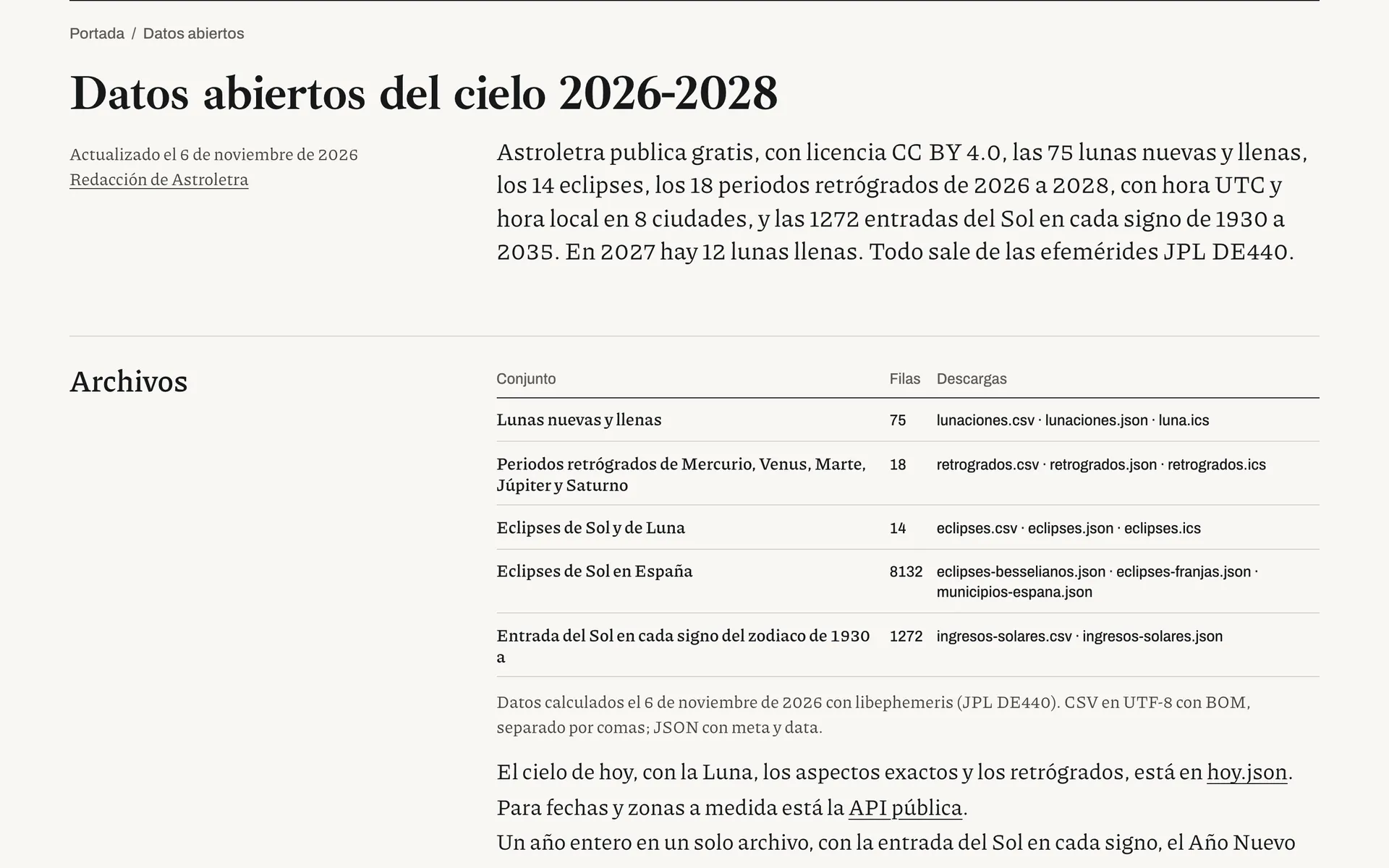
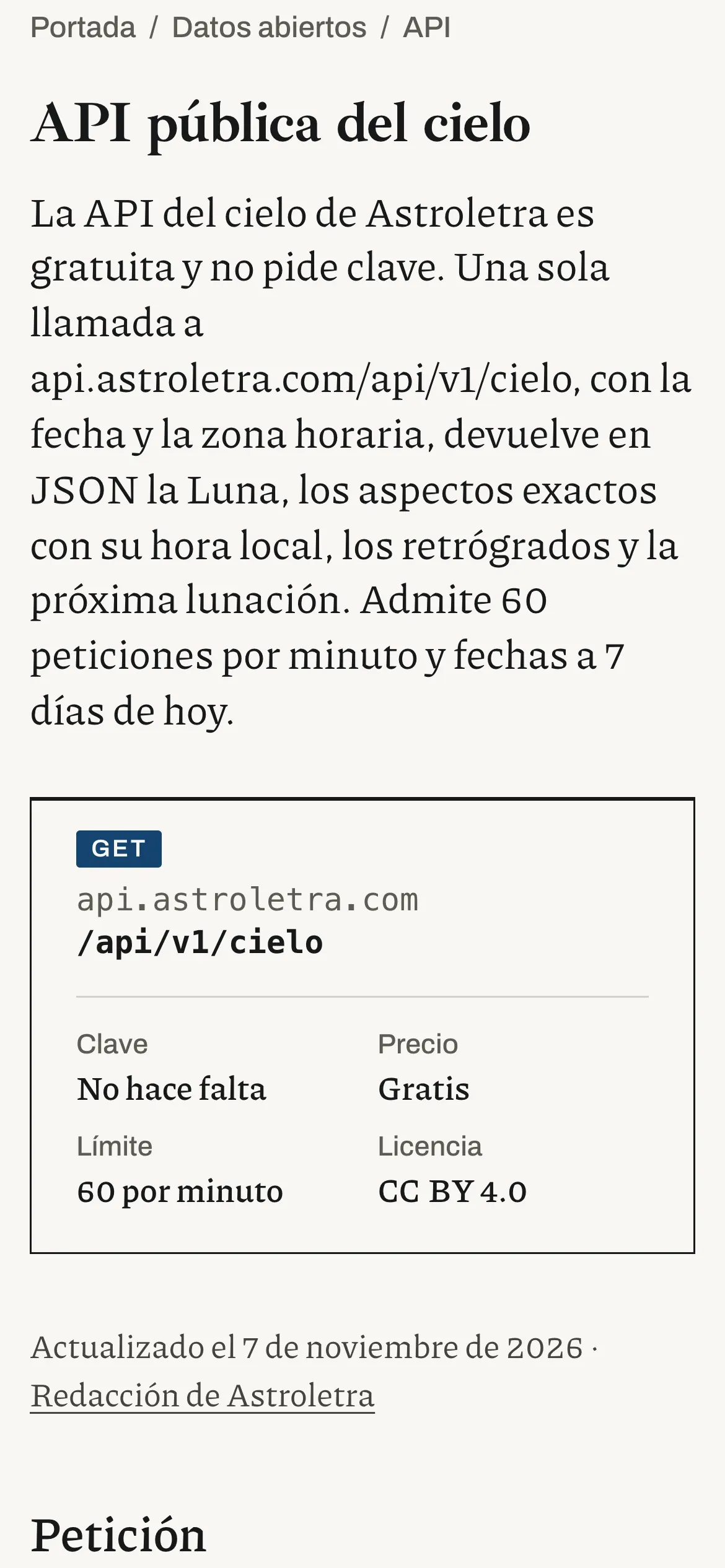
The open data on a computer and the public API on a phone, on 19 November 2026. Screenshots by crida studio.


What we did
The whole website, from the design of the first page to the data you can download.
- Logo and lookThe tile with the A, the name and the brand colours.
- Website designFrom the home page to the last entry, in light and dark.
- DevelopmentThe pages, the search and the navigation.
- Calculation engineWith the JPL DE440 ephemerides, for the Moon, the eclipses and the planets.
- Eclipse town by townAll 8,132 towns in Spain, with the map of the band.
- Open dataAs CSV, JSON and iCal, on Zenodo with a DOI, GitHub and Hugging Face.
- Public APIFree and with no key, described in OpenAPI.
- CalendarsTo subscribe to the moons, the eclipses and the retrogrades.
- SEOSo every page can be found and understood on Google.
Questions about the project
Do you build websites from your own or calculated data?
Yes. Astroletra is an example, with pages built from calculated data that anyone can check. If you have data you want to turn into useful pages, tell us what you have and how you use it now.
What does publishing open data with a DOI mean?
That the data can be downloaded and cited with a permanent identifier. Astroletra’s data is on Zenodo with a DOI that always points to the latest version, under a CC BY 4.0 licence, and the website explains how to cite it.
Can a free API end up being expensive?
It can, if it has no limits. The Astroletra API needs no key and no sign-up, but it allows 60 requests per minute and only dates up to seven days from today, and anyone who wants three years of data downloads it as files.
Do you work on projects outside Catalonia?
Yes. Astroletra is for readers in Spain and Latin America, and we work remotely with companies all over Spain and abroad.
Credits
- Brand, design, development, calculations, API, open data and SEO
- crida studio
- Ephemerides
- JPL DE440, from NASA’s Jet Propulsion Laboratory
- Towns
- Spain’s National Statistics Institute (INE)
- Screenshots on this page
- crida studio, 19 November 2026

Published Updated
Have data you want to turn into a website?
If you have your own data and want people to be able to look it up, cite it or use it, tell us what you have and we will tell you where we would start.