

On this page
How many biosimilars the EMA has authorised and who holds them
The EMA's public medicines file shows 152 biosimilars for human use with the status authorised. They cover 27 different active substances and 41 marketing authorisation holders. In the EMA's words, a biosimilar is a biological medicine highly similar to another one already approved in the EU, known as the reference medicine.
The file also keeps the ones that left or never made it. There are 22 withdrawn biosimilars, 14 withdrawn applications, 2 refused and 1 lapsed. Another 5 have the status opinion, meaning the EMA's scientific committee has given an opinion but they are not yet listed as authorised.
For a supplier, every holder is a potential account. Behind each authorisation is a biological medicine made from living cells or organisms, in the holder's own plant or at a CDMO. The holder is not always the manufacturer, but it is the first name to look at.
How many biosimilars were authorised each year
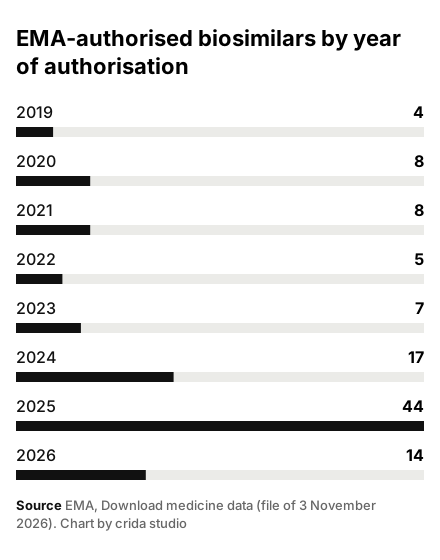
2025 is the year with the most biosimilars still authorised today. There were 44, more than double the 17 from 2024. 2026 already has 14 up to 3 November. Adding up the three years, 75 of the 152 have an authorisation date from 2024 onwards.
Before that, the peak came in 2017 and 2018, with 11 and 14. Between 2019 and 2023 there are 4 to 8 a year. Only medicines that are authorised today count here. Withdrawn ones are left out, so the older years look smaller than what was actually approved.
| Year | Biosimilars |
|---|---|
| 2019 | 4 |
| 2020 | 8 |
| 2021 | 8 |
| 2022 | 5 |
| 2023 | 7 |
| 2024 | 17 |
| 2025 | 44 |
| 2026 | 14 |
What is a biosimilar according to the EMA?
For the EMA, a biosimilar is a biological medicine highly similar to another one already approved in the EU in structure, biological activity, efficacy, safety and immunogenicity. It is not treated as a generic, because the natural variability and more complex manufacturing of biologics do not allow an exact copy. The EU approved its first biosimilar in 2006.
Which molecules have the most authorised biosimilars
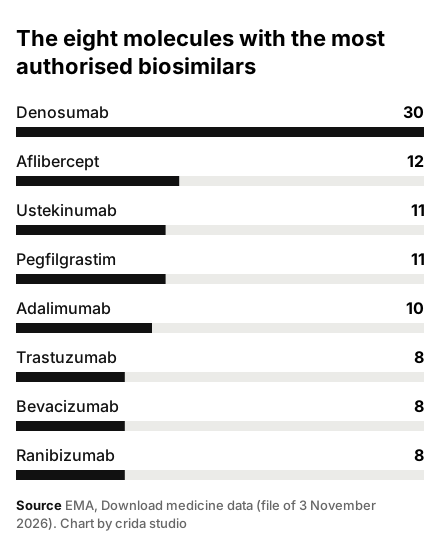
Denosumab is the molecule with the most authorised biosimilars, with 30. Next come aflibercept with 12, ustekinumab and pegfilgrastim with 11 each and adalimumab with 10. Trastuzumab, bevacizumab and ranibizumab have 8 each. The other 19 molecules have 7 or fewer.
The 2025 jump has clear names behind it. Of the 44 biosimilars authorised that year, 26 are denosumab and 8 are aflibercept. For denosumab, 26 of its 30 authorised biosimilars date from 2025. In this molecule, most competitors arrived in the same year.
The 5 files with the status opinion are ranibizumab, filgrastim, omalizumab, pertuzumab and pegfilgrastim. Omalizumab and pertuzumab have only 1 authorised biosimilar each today. For these two molecules, only a few companies have reached this stage.
| Molecule | Biosimilars |
|---|---|
| Denosumab | 30 |
| Aflibercept | 12 |
| Ustekinumab | 11 |
| Pegfilgrastim | 11 |
| Adalimumab | 10 |
| Trastuzumab | 8 |
| Bevacizumab | 8 |
| Ranibizumab | 8 |
Want us to check which holders on this list fit what you sell? Leave your details and we will tell you where we would start.
Check the listWhy biosimilars arrive in waves
Authorisations follow the timeline of the reference medicine. The EMA explains that a biosimilar can only be authorised once the data exclusivity period of the reference medicine has expired. In general, the reference medicine must have been authorised for at least eight years before another company can apply for approval of a biosimilar.
For marketing, that buys you time. Before authorisation, the EMA requires comparative quality, non-clinical and clinical studies. We have no data on when each company buys. But those studies need a working production process, so our reading is that much of the process buying happens earlier. If you wait for the approval news, you may be late.
So it pays to watch two things. Holders that already have authorised biosimilars know the route and can run it again with another molecule. Files with the status opinion show which biosimilars are about to arrive, and for which molecules.

When can a biosimilar of a given molecule be authorised?
According to the EMA, once the data exclusivity period of the reference medicine has expired. In general, the reference medicine must have been authorised for at least eight years before another company can apply. For a specific molecule you need to check its own documents, and patents are a separate question that this guide does not cover.
How to use this list in your marketing
The EMA list is public, free and easy to filter in a spreadsheet. With the filters in this guide, your marketing team gets an account base sorted by molecule and date that it can share with sales.
This is where we work with suppliers in the sector. We help turn public data like this into account lists, messaging and web content for each type of buyer, without promising results that depend on each market.
- Build an ABM account list with the 41 holders, separating those with several biosimilars from those with one.
- Cross it with LinkedIn to find the process development, manufacturing, quality and procurement people at each holder.
- Book trade show meetings with holders of the molecules that just came in, such as denosumab and aflibercept.
- Add a page to your website for biosimilar developers that covers scale-up, comparability and supply.
- Repeat the download before each campaign and check which files have changed status.
Can a biosimilar be used instead of the reference medicine?
The EMA and the Heads of Medicines Agencies (HMA) state that biosimilars approved in the EU are interchangeable from a scientific viewpoint, including between biosimilars of the same reference. Each member state decides whether pharmacies can substitute automatically. So one molecule can have the reference medicine and several biosimilars on the market side by side, as the counts in this guide show.
How we counted and what the data does not say
We downloaded the file Medicines output, medicines report from the EMA's Download medicine data page. The EMA generated it on 3 November 2026 at 6 am and we downloaded it the same day. We kept the rows with category Human and Biosimilar Yes. That gives 196 rows, and 152 have the status Authorised.
We counted holders without regard to upper or lower case. For the yearly count we used the marketing authorisation date. One authorised medicine, Pavblu, has no such date in the file and is left out of the yearly count, which therefore adds up to 151.
There are limits. The EMA itself says it evaluates the majority of biosimilar applications in the EU, not all of them. We count authorisations, not sales or production volume. One molecule can have several brand names from the same holder.
