
On this page
First, check where your customers come from
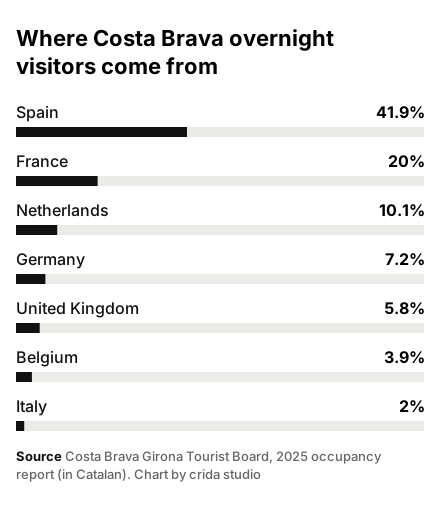
Before translating anything, look at who actually visits you. According to the Costa Brava Girona Tourist Board, in 2025 visitors from Spain, Catalans included, accounted for 41.9% of the nights spent in Costa Brava accommodation. The rest, almost six in ten, were spent by visitors from abroad.
The largest foreign market is France, with 20.0% of nights. Next come the Dutch with 10.1%, Germans with 7.2% and the British with 5.8%. So for many businesses on the coast, French can matter as much as English. Check your bookings, enquiries and analytics before you decide.
| Market | Share of nights |
|---|---|
| Spain | 41.9% |
| France | 20% |
| Netherlands | 10.1% |
| Germany | 7.2% |
| United Kingdom | 5.8% |
| Belgium | 3.9% |
| Italy | 2% |
Which pages to translate first
Translate the pages that lead to a booking or an enquiry first. That means the home page, the page for each service, room or product, prices and conditions, how to get there and contact. The blog and news can wait.
Three well-written pages in English do more than a whole site half translated. If a foreign customer lands on an English page and one click later everything is in Spanish or Catalan, they leave and look somewhere else.
If most of my customers are French, do I need English at all?
It depends on who visits you. On the Costa Brava in 2025, French visitors accounted for 20.0% of nights, while Dutch, German and British visitors together made up 23.1%. A single English version can serve many of them. If your customers are mostly French, it may make sense to start with French.
What a customer from abroad needs to read
A foreign customer doesn't know the town or how things work here. The English version has to answer what a local customer already knows. If they can't find it, they email you with questions or book somewhere else.
- Prices in euros and what they include, with taxes and extras made clear.
- Season dates and opening hours, including the days you close.
- How to get there from Girona or Barcelona airport and where to park.
- A phone number with the +34 prefix and WhatsApp if you use it.
- Payment methods and cancellation terms.
- Which languages your staff speak on the phone or on site.
Want to know whether your English site answers what customers from abroad ask? Leave your details and we will take a look.
Review my siteUse machine translation as a first draft
A machine translation tool or AI is fine to get started, but someone with good English should review the result. Google's spam policies say it doesn't want pages produced at scale through automated transformations such as translating, when they add little value for readers.
Check names of dishes, services and places in particular, because translation tools often change them. And don't mix languages on one page. Google says it works out a page's language from the visible text, not the code, and recommends one language per page, menus included.
Can I just add a button that translates the site automatically?
It helps visitors who are already on your site, but it is unlikely to bring you new customers from Google. If the text changes without a separate address for each language, Google may not find those versions. An /en/ folder with reviewed text can appear in English-language searches.
Give each language its own address
Each language needs its own address, for example an /en/ folder on the same domain. Google recommends separate URLs for each version rather than switching the text with cookies or browser settings, because that way it can find and show every version.
The versions are linked with hreflang tags. Each page must list itself and every other version, and those versions must list it back. If the return link is missing, Google may ignore the tags or misread them.
- Add a visible language switcher to every page.
- Don't redirect visitors to a language based on their IP address or browser. Google advises against it.
- Translate the title and description of each page too, since that is what appears on Google.
Do I need a separate domain for English?
No. An /en/ folder on the same domain is easy to set up and maintain, according to Google, because everything stays on the same host. Google says country domains such as .fr or .de send a strong signal about which country a site targets, which suits a business that works for a single country.
How to keep the versions in step
The usual problem comes after the translation, when the versions drift apart. You change a price or opening hours in Catalan and the English page still shows last year's. Keep a list of the pages with details that change and update them all together whenever you touch one.
Before the season starts, go through the English site as if you were a customer. See whether you can book or send a message without switching language. In Search Console you can filter performance by country and see whether the English pages show up in searches from abroad.
