

On this page
What goes into a website for a hotel, campsite or holiday rental
An accommodation website has to show what a stay is like, let guests book without going through a booking portal and show up when someone looks for somewhere to stay in the area. That is why we plan design, copy, booking, languages and SEO together from the start.
Each type of accommodation has its own booking journey. A campsite sells pitches and bungalows, a hotel sells rooms and a country house is often rented out whole. A campsite on the Costa Brava needs a different website structure from a country house inland in the Selva.
- Website design and development, in WordPress or fully custom.
- Integration with the booking engine you already use, as far as it allows.
- Versions in your guests’ languages, with hreflang tags.
- SEO for the key pages, structured data and the same name, address and phone number as your Google Maps listing.
What we found on 675 Girona accommodation websites
Our study analysed the home pages of 675 hotel, campsite, country house, guesthouse and apartment websites across the province of Girona on 31 October and 1 November 2026. Of these, 487 (72.1%) have a booking engine or button and 515 (76.3%) offer two or more languages. Yet only 103 (15.3%) use structured data to tell Google they are a lodging business.
These figures are minimums, because our program reads the HTML without running JavaScript and misses anything that loads later. Even so, they show where there is most room to improve. Most sites (617, or 91.4%) adapt to mobile screens, but fewer than a third tell Google what type of accommodation they are or show prices on the home page.
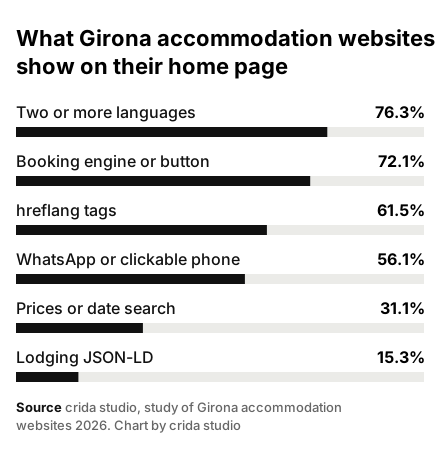
| Element on the home page | Share of websites |
|---|---|
| Two or more languages | 76.3% |
| Booking engine or button | 72.1% |
| hreflang tags | 61.5% |
| WhatsApp or clickable phone | 56.1% |
| Prices or date search | 31.1% |
| Lodging JSON-LD | 15.3% |
Can you connect the website to the booking engine I already use?
It depends on the engine. Some can be embedded in the page and others open their own booking page, often on a subdomain. We first check what options yours offers and how the journey looks on a phone. If anything limits the integration, we will tell you before design work starts.
Direct booking that works all the way through
A booking button is not enough if it leads to a form or to a page the guest does not understand. In the study, 196 of the 675 sites (29.0%) only have a booking button or link, which may lead to an engine or to a contact form. That is why we test the whole journey, from the home page to the booking confirmation.
If you already use a booking engine, we first check what it allows and how it fits into the website. If bookings start with an enquiry, the website should say so clearly and ask only for what is needed, such as dates and number of guests.
It also helps to keep a clickable phone number or WhatsApp link and prices or a date search close at hand. In the study, 379 sites (56.1%) have WhatsApp or a clickable phone number, but only 210 (31.1%) show prices or a date search on the home page.
How many languages should an accommodation website have?
The languages your guests speak. In our study of 675 accommodation websites in Girona, English appears on 71.0% and French on 61.9%. A few well-translated languages with hreflang work better than many half-finished ones. If you have booking data by country, it helps us decide where to start.
Languages for guests from abroad
If your guests come from France, the Netherlands or Germany, your website should speak their language. In the study, English appears on 71.0% of sites, French on 61.9%, German on 23.9% and Dutch on 13.3%. On the Costa Brava, 402 of 503 sites (79.9%) offer two or more languages.
Each language needs its own URL and hreflang tags, so Google knows which version to show to whom. Google explains that localised versions of a page are only treated as duplicates if the main content is left untranslated. That is why each version carries the full translated text, not just the menu, and links to all the others.
Google Maps, SEO and data Google can understand
When someone searches for a place to stay nearby, Google shows local results in Maps and Search. According to Google Business Profile Help, these results are mainly based on relevance, distance and prominence. Prominence also takes into account reviews and how many websites link to the business. Your website should show the same name, address and phone number as your listing.
For SEO, each room type, pitch or house is best given its own page, with a clear title, a meta description and a single H1. In the study, 73.6% of sites have a meta description and 53.9% a single H1. Structured data from schema.org tells Google what kind of accommodation you run. Types include Hotel, Campground, BedAndBreakfast and VacationRental.
Will a new website make me less dependent on Booking.com?
We cannot promise that. A website can make it easier for people who already know you to book directly, but bookings also depend on price, availability, reviews and day-to-day work. To see whether it is working, compare direct and portal bookings over time, across similar seasons.
The Can Junqué project
For Can Junqué, a rural hospitality project with direct booking, we worked on identity, photography, UX/UI, web development and integrations to build an independent booking channel. The project shows how presenting a place and booking it can be part of the same experience.
The case describes the work we did. A website alone does not guarantee higher occupancy, and a system that suits a country house may not be the best fit for a campsite or a hotel.
How do I get my accommodation to appear on Google Maps?
You appear on Google Maps through a Google Business Profile. Google says complete and accurate information helps a business show up in local search. On the website side, we check that the name, address and phone number match the listing and that the listing links to the right page.
How we work and what we need to get started
We start with how you receive bookings today, where your guests come from and which languages they speak. Then we review your current website against the study criteria, agree the structure and move on to design and development. Before going live, we test the booking flow on a phone in every language.
- Your current website, if you have one, and a link to your Google Business Profile.
- How you manage availability today, and which booking engine you use, if any.
- Where your guests come from and which languages they speak.
- Any photos and copy you already have of the property.
