

On this page
What equipment buyers actually type into Google
People buying equipment rarely type just the equipment name. They type the application, the scale and a condition or two, such as «50 L single-use bioreactor for cell culture» or «TFF system to concentrate antibodies at pilot scale». These searches have little volume, but whoever runs them often has a project on the table already.
Google's SEO starter guide points the same way. It says people who know a topic well use different words from newcomers, and that it pays to write with those differences in mind. It also says you do not need to anticipate every variation, because its systems understand how a page relates to many queries.
A keyword map by application and scale, not by model
Only people who already know you search for model names. To reach new buyers, lay your keywords out on a grid. One axis holds applications, such as monoclonal antibodies, vaccines, cell and gene therapy or precision fermentation. The other holds scales, from the lab to pilot plant and GMP production. Every cell with real demand deserves its own page.
The data to fill the grid comes from three places. The queries already bringing visits in Search Console, the questions your sales team gets by email and at trade shows, and the wording customers use in their user requirement specifications, or URS. Anything that shows up nowhere does not need a page of its own.
| Page type | Example search | Who runs it |
|---|---|---|
| Application | bioreactor for cell therapy | Process development |
| Scale | 200 L single-use bioreactor | Engineering and pilot plant |
| Comparison | stainless steel or single-use for vaccines | Technical management and procurement |
| Validation | TFF supplier with IQ and OQ support | Quality and validation |
How long does SEO take to show results for an equipment manufacturer?
Google says some changes take effect within hours and others can take several months, and it suggests waiting a few weeks before assessing the impact. Equipment makers also have a long buying cycle on top of that. So it makes sense to watch queries and visits to application pages first, and then the quote requests those pages generate.
The pages an engineer bookmarks
Some pages a process engineer saves and keeps coming back to. Application notes with test data, scale-up tables with working volumes, material compatibility lists, or a clear account of what the FAT, SAT, IQ and OQ documentation covers. They are useful before and after the purchase, which is why they belong on a manufacturer's website.
Google asks for people-first content with original information and first-hand expertise, the kind that comes from actually using a product. A manufacturer has it, because it designs, builds and tests the equipment. Put that data in the page text and keep the PDF as a download, so it can be read without opening a file.
Want us to check which applications and scales already bring you visits? Leave your details and we will tell you which page we would build first.
Review my SEOHow to structure the site so Google understands it
Google recommends descriptive URLs and explains that, on sites with thousands of URLs, grouping topics in directories helps it learn how often each part changes. For a manufacturer, one directory for applications and another for product ranges or scales makes sense. It also notes that keywords in the domain or URL alone have hardly any effect, and that it ignores the meta keywords tag.
For equipment, Google offers two kinds of product structured data. Product snippets are for pages where people cannot buy directly, which is the usual case for equipment sold on quotation. Merchant listings are for pages where customers can buy from you, such as an online shop for consumables.
Do we need an English website if we sell outside Spain?
If you sell abroad, almost certainly yes, because much of the sector's vocabulary is in English. If you have customers or distributors in Germany or the Nordics, consider German or other languages as well. Each language needs its own pages, reviewed by someone who knows the process vocabulary, rather than an unreviewed machine translation.
A real example for the search «filtración tangencial»
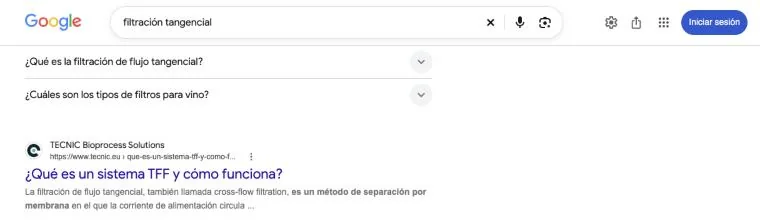
On 1 November 2026, a signed-out search on Google Spain for «filtración tangencial», Spanish for tangential flow filtration, returned the TECNIC Bioprocess Solutions page «¿Qué es un sistema TFF y cómo funciona?» as the first organic result. For «TFF system», a TECNIC video ranked second.
David Monje, founder of crida studio, led marketing at TECNIC for four and a half years and built B2B funnels there with SEO, SEM and automation. These results are part of the work he led there, and they are no guarantee that the same will happen for another company. They do show that a page that explains a process well can reach the top of a generic search.
A page that explains a process also draws students and the curious. That is why it needs clear links to application pages, documentation and contact details, so an engineer who arrives with a real project knows where to go next.
Can we rank for «bioreactor» or «TFF»?
These searches are highly contested and mix buyers, students and the curious. The TECNIC example shows that a good explanatory page can get in, but there is no guarantee. For a mid-sized manufacturer, it is more realistic to start with searches that combine application and scale, which have less volume but far more buying intent.
How to tell whether SEO brings in buyers
The Search Console Performance report shows the queries that bring clicks, the pages that receive them and the countries they come from. Filter it by the terms for each application and scale and check whether long queries are growing. Google warns that some changes show up in hours and others take months, and suggests waiting a few weeks before judging them.
Visits do not buy equipment, though. Record on the website and in your CRM which page each quote request comes from. That tells you which applications bring real projects and where you need to write more. We always start with this review before proposing new pages.
