

On this page
How an AI answer is put together when someone looks for suppliers
Google explains that AI Overviews and AI Mode may use a technique it calls query fan-out. The system runs several related searches across subtopics and data sources and uses the results to write the answer, with links to the pages that support it. If a buyer asks for single-use bioreactors for cell therapy, the answer can draw on manufacturer sites, directories and articles.
To appear as a supporting link, Google only requires the page to be indexed and eligible to show in Search with a snippet. There are no extra requirements. For ChatGPT, OpenAI says sites that block its OAI-SearchBot crawler will not be shown in ChatGPT search answers, although they can still appear as navigational links.
One page per application, with the data written as text
Buyers rarely type just «bioreactor». They ask about a volume, an application and a type of system. Monoclonal antibodies, vaccines, cell and gene therapy or precision fermentation each deserve their own page, with scales, materials, control options, single-use or stainless steel and the documentation you supply. Google recommends making important content available as text, not only in a PDF or an image.
Google also warns against the opposite. Creating pages for every search variation just to show up in AI answers breaks its scaled content abuse policy. Its guide to generative AI search asks for original content based on first-hand experience. For an equipment maker that means test data, scale-up cases and application notes built from your own work.
Do I need an llms.txt file or special markup to appear in Google's AI features?
For Google, no. Its documentation says you do not need new machine-readable files, AI text files or special markup, and there is no special schema.org structured data for this. Other assistants may work differently, but the foundation is the same, a page that can be crawled and indexed, with its content available as text.
Company details that are clear and consistent everywhere
An AI system has to understand who you are before it cites you. Your company page should state in text what you make, for which applications, across which volume range, where you manufacture and which markets you sell into. The same name and details should appear on LinkedIn, Google Business Profile, industry directories and trade show exhibitor listings.
Google recommends keeping Merchant Center and Business Profile information up to date and making sure structured data matches the visible text on the page. If one place says you build systems up to 500 litres and another says 1,000, the answer may pick the wrong figure.
Want us to check whether your website, LinkedIn page and trade show listings say the same thing? Leave your details and we will tell you what to review first.
Check my listingsWhere you should be mentioned beyond your own website
Because answers draw on several sources, your website alone is not enough. Exhibitor lists at shows such as ACHEMA or BioSpain, member pages of industry associations and articles in trade media all describe who does what. If you appear there with a clear description that matches your website, AI systems have more than one place to find you.
- Your exhibitor profile at every show, with the same description as your website.
- Member pages of the associations you already belong to.
- Articles and application notes in trade media, based on your own data.
- Published case studies with customers who have given written permission.
Is GEO or AEO different from SEO?
Google says that optimising for generative AI search is optimising for the search experience, so it is still SEO. It also suggests reviewing third-party advice sold as AEO or GEO carefully. What changes is how you test the results, with longer questions and across several assistants rather than one ranking report.
A real example for the search «bioreactor»
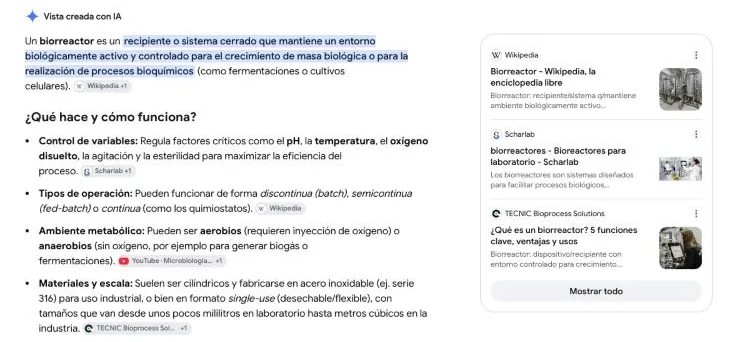
On 1 November 2026 we searched «bioreactor» on Google Spain from a browser with no account signed in. In Google's AI answer, TECNIC Bioprocess Solutions is cited as a source, with one of its articles on what a bioreactor is.
David Monje, founder of crida studio, led marketing at TECNIC for four and a half years, and that content is part of the work he led there. It does not mean the same will happen for another company. It does show that a page explaining an industry concept well, with clear data, can make it into the answer to a broad query.
If I block AI crawlers, will I disappear from ChatGPT?
It depends on which one you block. OpenAI separates GPTBot, which signals whether content may be used to train its models, from OAI-SearchBot, which is used for search. You can block the first and allow the second. If you block OAI-SearchBot, your site will not appear in ChatGPT search answers, although it can still show up as a navigational link.
How to test the questions a buyer would really ask
Write the questions the way a buyer would, not the way your marketing team would. Ask them in ChatGPT, Google AI Mode and other assistants without signing in, and note who appears and which sources are cited. Repeat it every month with the same questions, because the answers change.
In Search Console, traffic from AI Overviews and AI Mode is counted in the Performance report under the Web search type. Also check that robots.txt and your CDN let Googlebot and OAI-SearchBot through. We run this check before touching any copy.
- Finding suppliers, such as «European manufacturers of 200 litre single-use bioreactors».
- Comparing, such as «stainless steel or single-use for a vaccine pilot plant».
- Validating, such as «TFF system suppliers with IQ and OQ support».
- The same questions in German or other languages if you sell abroad.
