

On this page
How many monoclonal antibodies the EMA authorises each year
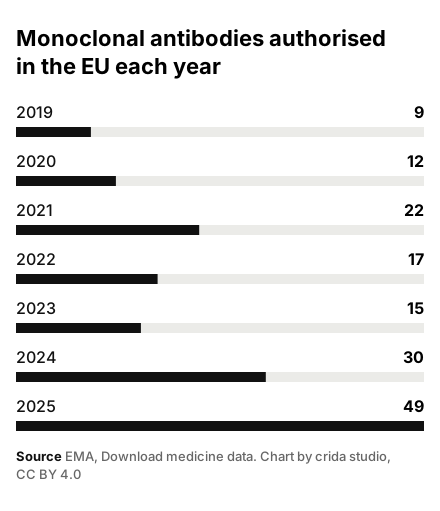
The EMA's medicines file holds 271 monoclonal antibodies for human use with an EU marketing authorisation. The first two date from 1996. 231 are still authorised today, and the other 40 were withdrawn, revoked, expired or lapsed. Each brand name counts once, so one molecule sold under two brands counts twice.
From 1996 to 2014 the number stayed small, between zero and six a year. 2015 and 2016 brought 10 and 8, and the big jump came in 2017 and 2018, with 20 and 22, when the biosimilars of rituximab, adalimumab and trastuzumab arrived. 2021 also reached 22. Then came 30 in 2024 and 49 in 2025, the highest figure in the file.
2026 has 13 so far, with the latest authorisation dated 18 September, far below the 49 of 2025. Six more antibodies sit in the file with the status Opinion. Five have a positive EMA opinion and are waiting for the European Commission decision, and one has a negative opinion.
| Year | Authorisations |
|---|---|
| 2019 | 9 |
| 2020 | 12 |
| 2021 | 22 |
| 2022 | 17 |
| 2023 | 15 |
| 2024 | 30 |
| 2025 | 49 |
Antibodies are now close to half of EU central approvals
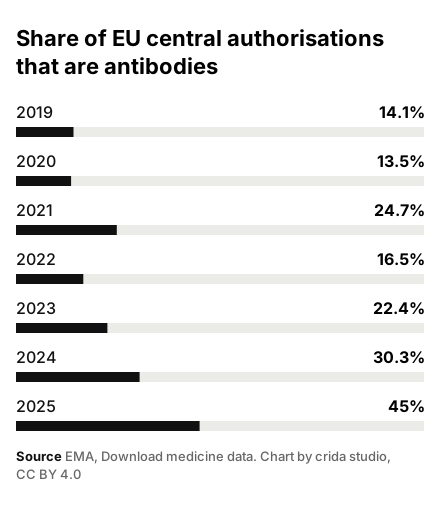
In 2025 the EU authorised 109 human medicines through the centralised procedure, and 49 of them were monoclonal antibodies. That is 45 %. In 2024 the share was 30 % and in 2019 it was 14 %. This counts all medicines in the file, including generics and biosimilars, by the date of their authorisation.
Over five-year periods the change is clearer. From 1996 to 2000 there were 10 antibodies out of 150 central authorisations, or 7 %. From 2021 to 2025 there were 133 out of 467, or 28 %. Medicines made by biotechnology must go through the EMA, so this file is the reference list for antibodies in the EU.
| Year | Share of authorisations |
|---|---|
| 2019 | 14.1% |
| 2020 | 13.5% |
| 2021 | 24.7% |
| 2022 | 16.5% |
| 2023 | 22.4% |
| 2024 | 30.3% |
| 2025 | 45% |
How many monoclonal antibodies are authorised in the EU?
In the EMA file of 10 November 2026 we found 271 monoclonal antibodies authorised since 1996, and 231 are still authorised. They are brand names, so one molecule can appear several times. Biosimilars share the name of their reference medicine, and counting each name once leaves 151 different antibody substances, with combinations counted as one.
Biosimilars drive the record, new antibodies keep a steady pace
Of the 49 antibodies authorised in 2025, 34 are biosimilars. 26 are denosumab, the bone medicine, and 5 are ustekinumab. In 2024 the wave was ustekinumab, with 9 of the 17 biosimilar antibodies. The 26 denosumab biosimilars of 2025 belong to 14 different holders, and the 9 ustekinumab ones of 2024 to 7.
New antibody substances follow another rhythm. We counted an antibody as new the first time its name appears in the file. There were 13 in 2021, 14 in 2022, 9 in 2023, 10 in 2024 and 13 in 2025, for 59 in five years. From 2016 to 2020 there were 40, and from 2006 to 2015 there were 31.
For a supplier these are two different buyers. A biosimilar developer already knows the molecule and competes on cost and on time to market. A company with a new antibody is still scaling up, often with a CDMO. Our guide on EMA-approved biosimilars lists every molecule and holder. The EMA's own 2025 report mentions 41 biosimilars, but that covers every type of biosimilar and counts opinions, not authorisation dates.
The 231 antibodies authorised today belong to 88 holders. Roche Registration has 15, Amgen Europe 12, Celltrion 11, Sandoz 10 and Samsung Bioepis 9. All of the Celltrion, Sandoz and Samsung Bioepis ones are biosimilars, and none of Roche's are. The holder is not always the manufacturer, but it is the first name on an account list.
| Year | Authorisations | Biosimilars | New substances | All central authorisations |
|---|---|---|---|---|
| 2015 | 10 | 0 | 9 | 93 |
| 2016 | 8 | 1 | 6 | 81 |
| 2017 | 20 | 11 | 9 | 92 |
| 2018 | 22 | 10 | 12 | 94 |
| 2019 | 9 | 3 | 6 | 64 |
| 2020 | 12 | 5 | 7 | 89 |
| 2021 | 22 | 8 | 13 | 89 |
| 2022 | 17 | 3 | 14 | 103 |
| 2023 | 15 | 5 | 9 | 67 |
| 2024 | 30 | 17 | 10 | 99 |
| 2025 | 49 | 34 | 13 | 109 |
| 2026 | 13 | 8 | 4 | 67 |
Which diseases and formats the new antibodies target
Cancer leads. Of the 59 new antibody substances from 2021 to 2025, 26 carry an ATC code for antineoplastic agents and 13 for immunosuppressants. Two more, for myeloma and lymphoma, had no ATC code yet in the file. The rest are spread wide, with 6 against COVID-19 and RSV, 3 for atopic dermatitis and 2 for haemophilia.
2025 brought lecanemab and donanemab, the first two antibodies for Alzheimer's disease in the file. It also brought garadacimab for hereditary angioedema and nemolizumab for prurigo. None of the four is a cancer drug, so the buyers of new antibodies are no longer only in oncology.
Conjugates are also growing. They join an antibody to a drug or a toxin, and their names carry a second word such as vedotin or deruxtecan. We counted 8 new ones from 2021 to 2025, against 4 from 2016 to 2020. Each one needs an antibody, a payload and a conjugation step.
Does every monoclonal antibody in the EU go through the EMA?
Medicines made with biotechnology, such as genetic engineering, must use the EU centralised procedure, which goes through the EMA. That covers monoclonal antibodies. So the EMA file is the most complete public list of antibodies authorised in the EU. It also keeps withdrawn medicines, with the authorisation date and status of each.
Want us to check which antibody holders fit what you sell? Leave your details and we will tell you where we would start.
Check the holdersWhy the newest antibodies no longer end in -mab
In October 2021 the WHO expert group on international non-proprietary names decided to stop using the -mab ending. It replaced it with four new endings, published in May 2022. -tug is for unmodified full antibodies, -bart for antibodies with an engineered constant region, -ment for fragments and -mig for bispecific and multispecific antibodies.
The first one is already authorised in the EU. Kavigale, with sipavibart, an antibody against COVID-19, got its authorisation on 20 January 2025. Frehemgo, with denecimig, a bispecific for haemophilia, has a positive opinion and is waiting for the Commission decision. Older names keep -mab, so both systems will live side by side, and a team that searches registers for -mab only will miss the new ones.
Is aflibercept a monoclonal antibody?
No. Aflibercept and etanercept are fusion proteins, a receptor joined to part of an antibody. Their names do not end in -mab and we left them out of the count. Many of their biosimilars appear in the same years, so mixing them in would inflate the 2025 figure for antibodies.
What the trend means for bioprocess suppliers
More authorised antibodies mean more commercial processes to supply, but the figures do not say who buys what or when. Our reading is that each biosimilar wave brings many holders at once and that each new substance brings one company that is still scaling up. Equipment and consumables makers can plan campaigns around both. Open clinical trials with antibodies show what may come next.
Sartorius describes its end markets as fundamentally healthy. In the Sartorius results for the first nine months of 2026, recurring consumables were the main driver, and the CEO said demand for bioprocess equipment and instruments continued to recover.
This is part of our marketing for biotech and bioprocess suppliers. We turn public registers like this one into account lists, messages for each type of buyer and web content that sales can use. We do not promise results, because they depend on each market.
How to rerun and use this count tomorrow
The EMA updates its data tables overnight, so you can repeat the count whenever you need it. A spreadsheet is enough. At the end you will have your own list of holders, sorted by molecule and by date.
- Download the medicines table from the EMA's Download medicine data page and keep the date.
- Keep the rows with category Human and look in the name columns for words ending in -mab, -tug, -bart, -mig or -ment.
- Use the marketing authorisation date for the year and the Biosimilar column for the type.
- Sort holders by number of antibodies and by year, and pass the list to sales with the molecule next to each name.
- Watch the rows with status Opinion and a positive opinion, which are the next authorisations, and rerun the count before each trade show or campaign.
How often can I update the count?
The EMA says it updates the download tables on its website overnight. The European Commission grants the authorisation within 67 days of the EMA recommendation, and until then the file shows the status Opinion. Running the count before each campaign or trade show is usually enough to catch the new holders and the files with a positive opinion.
How we counted and what the data does not say
We downloaded the Medicines output file from the EMA on 10 November 2026. The EMA generated it that day at 6 pm. We kept 2,357 human medicines and looked for an antibody name in the international non-proprietary name or the active substance. That gave 311 rows, and 271 have a marketing authorisation date.
The count includes withdrawn medicines, so older years are complete. It includes four imaging antibodies from the 1990s. It leaves out fusion proteins such as etanercept and aflibercept, which are not antibodies. The Biosimilar column is the EMA's own, and a product marked as not biosimilar is not always a new molecule.
We count authorisations, not sales, doses or production volume. Each brand counts once, and some holders register two brands of the same molecule. 2026 is partial. The download on this page has the figures of the charts. We also keep the list of 271 medicines with their EMA number.
