

On this page
How many advanced therapies are authorised in the EU
The EMA medicines file lists 24 advanced therapies for human use with the status authorised. According to the EMA, all advanced therapy medicines are authorised centrally through the agency, so this file covers every EU authorisation.
The EMA defines them as medicines for human use based on genes, tissues or cells. There are three main types, gene therapies, somatic cell therapies and tissue-engineered products. Since 2009, 33 have held an EU authorisation at some point, and 9 of them no longer do.
How many have been approved since 2009
Approvals have picked up, but the numbers are still small. Between 2009 and 2014 there were 4, and between 2015 and 2017 there were 5. Since 2018 each three-year period has brought 8, and the latest one is not over yet. 2026 already has 3, Waskyra in January, Adstiladrin in May and Itvisma in June. Waskyra is one of the advanced therapies the EMA recommended in 2025.
This count includes all 33 that have held an authorisation at some point, including those that later lost it. According to the EMA's Committee for Advanced Therapies, 50 applications were submitted between 2009 and February 2026, with 32 positive opinions, 7 negative ones and 13 withdrawals. Cell and gene therapy clinical trials show what may come next.
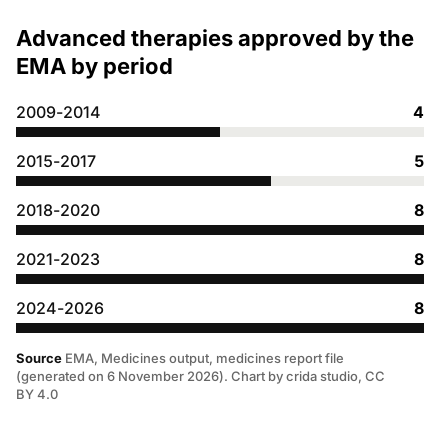
| Period | Therapies approved |
|---|---|
| 2009-2014 | 4 |
| 2015-2017 | 5 |
| 2018-2020 | 8 |
| 2021-2023 | 8 |
| 2024-2026 | 8 |
How many cell and gene therapies are approved in Europe?
The EMA file downloaded on 6 November 2026 lists 24 advanced therapies authorised in the EU, from 18 holders. Since 2009, 33 have been authorised, and 9 of them no longer are. On the March 2026 list from the Committee for Advanced Therapies, 22 of the 31 products are gene therapies.
Most approved ATMPs are gene therapies
The Committee for Advanced Therapies list from March 2026 has 31 products. 22 are gene therapies, 5 are somatic cell therapies and 4 are tissue-engineered products. The list includes withdrawn products and ends with Waskyra, authorised in January 2026.
CAR-T therapies such as Kymriah, Yescarta and Carvykti appear on that list as gene therapies. Cell and tissue products are fewer, and their holders include companies such as Holostem, CO.DON and Cordex Biologics. For a supplier, the therapy type tells you what kind of process sits behind each account.
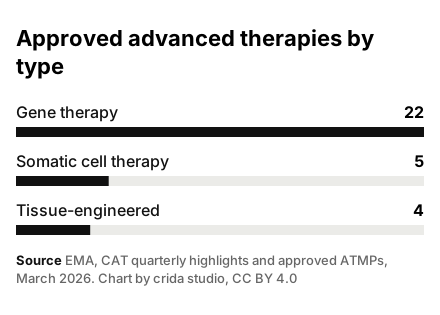
| Type | Products |
|---|---|
| Gene therapy | 22 |
| Somatic cell therapy | 5 |
| Tissue-engineered | 4 |
Want to know whether your website answers what a gene therapy company would look for? Leave your details and we will take a look.
Take a look9 of the 33 are no longer authorised
Of the 33 advanced therapies that have been authorised, 9 no longer are. 7 are listed as withdrawn and 2 as expired. The withdrawn products include Zynteglo, authorised in 2019 and withdrawn in March 2022, and Beqvez, authorised in July 2024 and withdrawn in May 2025.
The file does not say why each one was withdrawn, and we do not guess here. What it does show is that an authorisation does not guarantee a product stays on the market. Skysona was authorised in July 2021 and, according to the committee's list, withdrawn in November of the same year.
For marketing, this means checking each account's status before running a campaign. A holder that has withdrawn a product may still have other projects under way, but the message and the timing will be different.
Where can I find the official EMA list of approved ATMPs?
There are two routes. The Medicines output file on the EMA's Download medicine data page can be filtered by the Advanced therapy column, although that flag is incomplete. The Committee for Advanced Therapies also publishes a quarterly report with the list of authorised products, their type and those withdrawn.
Who holds the approved advanced therapies
The 24 authorised products belong to 18 holders. Novartis has 4, Kymriah, Zolgensma, Luxturna and Itvisma. Fondazione Telethon, Bristol-Myers Squibb and Kite Pharma have 2 each. The rest have 1, from Ferring and Amgen to Autolus and Holostem. Next to EMA-approved biosimilars, which are far more numerous, this is a market with very few names.
The flags in the file add context. 17 of the 24 are orphan medicines, 14 went through the EMA's PRIME scheme and 8 have a conditional marketing authorisation. 22 are under additional monitoring, and 9 carry ATC code L01, the code for antineoplastic agents.
How to use this list in your marketing
With 24 products and 18 holders, this market calls for an account-by-account marketing strategy. The whole list fits in a spreadsheet, and each name comes with a therapy, a date and a status that are all public. The holder is not always the manufacturer, but it is the first name to check.
Our marketing for biotech companies service turns public data like this into target account lists, a message for each type of buyer and the web pages those buyers will check, without promising results that depend on each market.
- Keep gene therapy accounts apart from cell and tissue therapy accounts, because their manufacturing processes are different.
- Check each account's status in the EMA file every quarter, because withdrawals are recorded there too.
- Build a cell and gene therapy page on your website, with datasheets, documentation and case studies these buyers can review.
Why have some advanced therapies been withdrawn?
The EMA file only gives the status and the date, not the reason. Each row links to the medicine's page on the EMA website, which is where to look case by case. We do not interpret it here. What the file does show is that 9 of the 33 approved therapies are no longer authorised.
How we counted and what the data does not say
We downloaded the Medicines output, medicines report file from the EMA's Download medicine data page. The EMA generated it on 6 November 2026 at 18.00 and we downloaded it the same day. We took the rows with category Human and the Advanced therapy flag set to Yes. That gives 36.
The flag is incomplete. Itvisma, authorised on 30 June 2026, has the same active substance as Zolgensma but is not flagged, and neither is an earlier withdrawn application for Roctavian. We added records with the same active substance as a flagged one, which gives 38, including the 33 authorised. All 31 products on the committee's list are there. For years we use the authorisation date.
There are limits. We count authorisations, not sales or patients treated. Some withdrawn or refused advanced therapy applications have no flag, such as Lumevoq, Artobend and Heparesc, so we do not give a total for applications. The therapy types come from the committee's March 2026 list, which does not include Adstiladrin or Itvisma. We have kept the list of the 38 records with names, statuses and dates.
