

On this page
What the EMA recommended in 2025
The EMA recommended 104 human medicines in 2025 and adopted a negative opinion on 7. Companies withdrew 22 applications before the assessment was finished. Of the 104, 38 had an active substance never authorised in the EU before. The EMA released these figures with its annual report on 11 June 2026, and the detail is in its Human medicines in 2025 overview.
These are recommendations, not authorisations. The EMA sends each opinion to the European Commission, which adopts the EU-wide marketing authorisation. The authorisation comes after the opinion, so an opinion adopted late in the year can become an authorisation the following year. That is why counts by authorisation date give different figures.
A record year for biosimilars, led by denosumab
Biosimilars were the largest group in 2025. The CHMP gave a positive opinion to 41, its highest number ever, and 23 of them contain denosumab, a monoclonal antibody for osteoporosis and bone loss. Since the biosimilar framework was set up in 2005, the committee has assessed 181 applications and approved 165.
The EMA presents biosimilars as a core tool for managing costs and widening access. Our guide to biosimilars authorised by the EMA counts 44 for 2025, 26 of them denosumab, because it counts products still authorised on 3 November 2026 by their Commission authorisation date. This report counts the committee's opinions in 2025. Both figures are right and measure different steps.
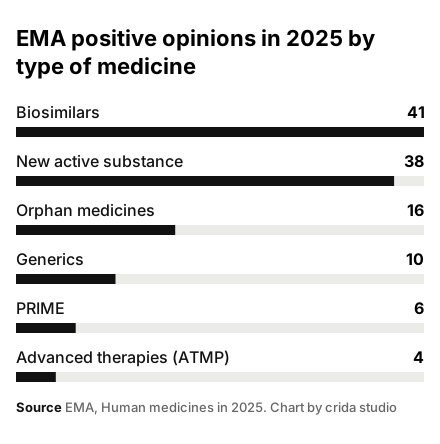
| Category | Positive opinions |
|---|---|
| Biosimilars | 41 |
| New active substance | 38 |
| Orphan medicines | 16 |
| Generics | 10 |
| PRIME | 6 |
| Advanced therapies (ATMP) | 4 |
How many medicines did the EMA recommend in 2025?
The EMA adopted 104 positive opinions on human medicines in 2025 and 7 negative ones, while companies withdrew 22 applications. Of the 104, 38 had a new active substance in the EU, 41 were biosimilars and 10 were generics. These are recommendations the EMA sends to the European Commission, which adopts the authorisation.
Few advanced therapies, all with a new active substance
Only 4 of the 104 recommendations were advanced therapy medicinal products, or ATMPs. They are Aucatzyl, a CAR-T therapy for a type of acute lymphoblastic leukaemia, Zemcelpro, an umbilical cord stem cell therapy for blood cancers, and Vyjuvek and Waskyra, two gene therapies for rare diseases. All four have a new active substance and three came through the PRIME scheme.
The 7 negative opinions include Elevidys, for Duchenne muscular dystrophy, and Jelrix, made from the patient's own cartilage-forming cells for knee cartilage defects. In therapies such as Aucatzyl or Waskyra, each dose is made from the patient's own cells, so batches are small and each one has to be tracked. Our count of cell and gene therapy trials in Spain helps show who works in this field.
Want us to check whether your website speaks to biosimilar and advanced therapy manufacturers? Leave your details and we will talk it through.
Let's lookWhich buyers to target
The 2025 mix points to three buyer groups with different needs. Before you split the budget, check how much weight each group carries in your customer base and where you have the strongest references to show.
- Biosimilar developers and their CDMOs. Many competitors share the same molecule, as denosumab shows. Talk about cost per batch, capacity and how fast you can scale.
- Companies with new active substances. There were 38, such as teplizumab to delay type 1 diabetes, teprotumumab for thyroid eye disease and donanemab for early Alzheimer's disease. Talk about yield, scale-up and GMP documentation.
- Advanced therapy developers. There are few of them and they work in small batches. Talk about closed systems, traceability and support to qualify the equipment.
How many denosumab biosimilars did the EMA recommend in 2025?
23 of the 41 biosimilars with a positive opinion in 2025 contain denosumab, a monoclonal antibody for osteoporosis, bone loss and other bone problems. According to the EMA, 41 is the highest number of biosimilars it has ever approved in a year. For a supplier, it means many products competing on the same molecule.
What messages and web content to prepare
Each group needs its own page on your site, with its problem in the headline. A biosimilars page can show how to move from lab to production on the same platform. An advanced therapies page can show the closed system and the paperwork. Both need datasheets and case studies people can download.
The EMA figures also work as material for your own content, such as an article or a customer email. Always cite the source and make clear these are recommendations. Putting this order in place is part of a supplier's marketing strategy, and it is worth doing before the trade show season.
Trade show conversations and buying timelines
On the stand, the 2025 report gives you an easy opening question. Ask each visitor whether they work on a biosimilar, a new active substance or an advanced therapy, and tailor the demo to the answer. If you are getting ready for a show like ACHEMA or CPHI, bring separate material for each group.
Timing matters too. Accelerated assessment, which 3 medicines received in 2025, takes 150 days at most instead of 210. We have no data on when each company buys. Our reading is that much of the process buying happens before the application, while manufacturing is being set up. If you wait for the recommendation news, you may be too late.
Which advanced therapies did the EMA recommend in 2025?
Four. Aucatzyl, a CAR-T therapy for leukaemia, Zemcelpro, an umbilical cord cell therapy for blood cancers, and Vyjuvek and Waskyra, two gene therapies for rare diseases of the skin and the blood. All four have a new active substance and three came through the PRIME scheme.
How to read the figures in the report
The categories overlap. One medicine can be a new active substance, an orphan, a PRIME medicine and an advanced therapy at once, as Zemcelpro is. The 16 orphans are those whose designation was confirmed by the end of 2025. And the 41 biosimilars include three duplicates, the same medicine under another brand name.
The report does not say how much will sell or who makes each medicine. To turn the figures into an account list, cross them with the holder of each authorisation and with ongoing trials. That is the work we do at crida studio in marketing for biotech and bioprocess companies, without promising results that depend on each market.
