

On this page
What percentage of revenue goes on marketing
The figure you see most often comes from Gartner. Its 2026 survey puts the average marketing budget at 7.8% of company revenue, almost unchanged from 7.7% in 2025. The 401 respondents were marketing leaders in North America, the UK and Europe, most of them at companies with more than $1 billion in annual revenue.
For a small business that percentage is misleading. A company turning over €400,000 that applied 7.8% would have €31,200 a year for marketing. A shop on tight margins cannot get there, and a new business may need more than its percentage just to become visible.
It works better the other way round. Start with what you cannot do without. Then price each piece and check how long it takes to pay off. Compare the total with your revenue to see whether you can afford it.
What the bare minimum costs
The minimum has three parts. A Google Business Profile, which Google says you can manage at no cost and which puts you on Maps and Search. A website of your own, where crida studio's simple template-based site of 3 to 5 pages starts at €1,200 excluding VAT. And the running costs every website has, whoever builds it.
A domain costs €10 to €40 a year, hosting €100 to €300 a year and maintenance, with updates, backups and monitoring, €60 to €150 a month. A simple website with domain and hosting comes to between €1,310 and €1,540 up front, plus monthly maintenance if you take it.
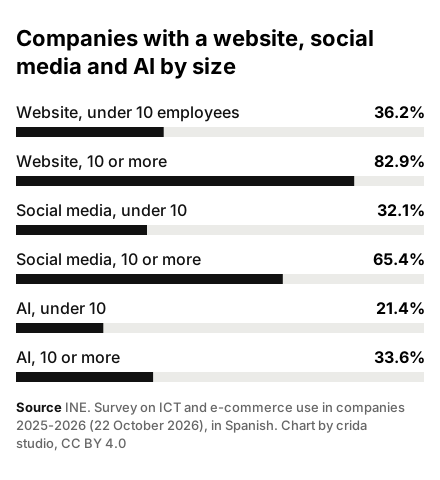
Many small firms in Spain still lack that minimum. According to Spain's National Statistics Institute (INE), in the first quarter of 2026 only 36.2% of companies with fewer than 10 employees and an internet connection had a website, against 82.9% of those with 10 or more. Social media shows the same gap, at 32.1% and 65.4%.
| Companies | Percentage |
|---|---|
| Website, under 10 employees | 36.2% |
| Website, 10 or more | 82.9% |
| Social media, under 10 | 32.1% |
| Social media, 10 or more | 65.4% |
| AI, under 10 | 21.4% |
| AI, 10 or more | 33.6% |
Can I start with just social media and a Google Business Profile?
You can, and Google says the profile costs nothing to manage. But social media and the profile are other people's platforms, and anyone who wants to know more about you ends up looking for a website. If money is very tight, start with a well-built profile and add a simple website, from €1,200 excluding VAT, as soon as you can.
What comes first, the website, SEO or Google Ads
The order depends on where the business is now more than on its sector. Don't pay to send people to a website that fails to convince them, and don't expect SEO to deliver if you need calls this month. With that in mind, most businesses fit one of these four cases.
If you can't tell which one is yours, the marketing diagnosis starts at €2,500 excluding VAT and ends in a twelve-month plan with a budget and the measures that show whether it works. Google suggests asking any SEO specialist what results they expect and by when, and warns that no one can guarantee a number one ranking.
- You have no website, or yours doesn't explain what you do. Start with the website and the Google profile, because everything else will send people there.
- Your website is fine and you can wait. Go for local SEO, which starts at €450 a month at crida studio and covers your Google profile, key pages and a monthly report. It needs three to six months at least.
- You need enquiries now. Run Google Ads, with a page ready to receive them and someone who replies the same day.
- You don't know where to start. Get a diagnosis before committing to anything else.
Can I run Google Ads myself to save the management fee?
Yes. The account is yours and you can create and run campaigns without a middleman. You save the management fee, which starts at €790 a month at crida studio, but the ad spend is the same. Allow for the hours it takes to set up and review campaigns every week, and track calls and form submissions from day one.
Have a figure in mind for 2027 but not sure how to split it? Leave your details and we'll go through it with you.
Go through itHow much to put into ads on top of management
Google Ads means two budget lines. Google Ads management, which starts at €790 a month at crida studio, and the ad spend itself, which you pay straight to Google from your own account. Management covers search campaigns, lead tracking and a monthly report, and makes sense from €900 a month in ads, because below that there is not enough data to improve the campaigns.
Over a year that is €9,480 for management and at least €10,800 in ads, or €20,280 excluding VAT. Keep that figure in mind before putting Google Ads into a €6,000 or €15,000 budget. Running the campaigns yourself saves the management fee, but the ad spend stays the same.
In Google Ads you set an average daily budget. Google explains that a campaign can spend up to twice that on a given day, but by the end of the month it will not have spent more than 30.4 times the daily figure. To reach about €900 a month, set €30 a day, which caps the month at €912.
Do these budgets include VAT?
No. Every figure excludes VAT, just like crida studio's pricing page. Ad spend is paid to Google from your own account. If you want to see the total with tax, the website budget calculator adds Spanish VAT on a separate line for each service you pick.
How to split €6,000, €15,000 or €30,000 a year
These three splits come from the starting prices crida studio publishes, excluding VAT, plus the running costs of any website. Each line is the minimum, with no extras. The first month of maintenance after launch is included, and after that maintenance is optional.
With €6,000, a new business or one without a website can get a simple site, a Google profile and six months of SEO. With €15,000, a company with an outdated website can start with the diagnosis, then build a custom site and run ten months of SEO once it is live. That still leaves €3,310 to €4,350 for website extras such as more pages, a second language or copywriting.
With €30,000, a company whose website already works can run a year of Google Ads at the minimum spend and a year of SEO side by side. The ads bring enquiries from the first month while SEO builds up. The €2,180 to €3,490 left over can go into extra ad spend in the busy months.
| Budget line | €6,000 a year | €15,000 a year | €30,000 a year |
|---|---|---|---|
| Google Business Profile | €0 | €0 | €0 |
| Website | Simple, €1,200 | Custom, €3,000 | Already in place |
| Marketing diagnosis | No | €2,500 | No |
| Monthly SEO | 6 months, €2,700 | 10 months, €4,500 | 12 months, €5,400 |
| Google Ads management | No | No | 12 months, €9,480 |
| Ad spend paid to Google | No | No | 12 months, €10,800 |
| Website maintenance | 11 months, €660 to €1,650 | 9 months, €540 to €1,350 | 12 months, €720 to €1,800 |
| Domain and hosting | €110 to €340 | €110 to €340 | €110 to €340 |
| Total excluding VAT | €4,670 to €5,890 | €10,650 to €11,690 | €26,510 to €27,820 |
How often should I review my marketing budget?
Every three months, using the enquiries that came in and what each channel cost. Ads can be adjusted more often, because you can change the daily budget whenever you like. SEO, on the other hand, needs three to six months at least before you judge it. Once a year, look at everything together and set the next year's budget.
What changes in 2027 with AI Mode and ChatGPT ads
Google's AI Mode is already live in Spain and supports Spanish and Catalan, according to Google's help centre. Google says there are no additional requirements to appear in it and that the usual SEO best practice still applies, such as keeping your Business Profile up to date. So it does not need its own line in the budget.
ChatGPT has shown ads in Spain since 24 August 2026, on the free and Go plans. At first, access ran through OpenAI's sales team and partner agencies, and OpenAI says advertising does not influence its answers. For a small business it is something to watch in 2027 rather than a line to fund from day one.
AI is also part of daily work now. According to the INE, 21.4% of Spanish companies with fewer than 10 employees and an internet connection were already using some form of AI in the first quarter of 2026. If you want a voice assistant on your website, crida studio’s Ona costs €149 a month with a 12-month commitment, plus a €750 setup, with AI usage and maintenance included.
What if no enquiries come in by mid-year?
First work out whether people can't find you, or find you and don't get in touch. If there are visits but no enquiries, the website or the offer is the problem, and more ad spend won't fix it. If there are no visits, check your Google profile, your SEO and your ad spend. A diagnosis helps you tell the two apart.
How to tell whether the budget works, and what to do tomorrow
A budget works if it brings enquiries that turn into paid work. Divide what you spent in a quarter by the enquiries you received and you have the cost of each one. Do it per channel, the Google profile, SEO and ads, and compare it with what a customer is worth to you.
To get those numbers, count calls and form submissions from day one, not just visits. Review the split every three months and move money to the channel that brings the cheapest enquiries. Give SEO time, because a single quarter is not enough to judge it. To start tomorrow, take these five steps.
- Write down what you spent this year on your website, ads, tools and suppliers, with the invoices in front of you.
- Count how many enquiries came in and through which channel.
- Check that your Google Business Profile is verified and complete.
- Decide which of the four cases above is yours.
- Pick the sample budget closest to it and fine-tune it with the calculator or a fixed quote.
