

On this page
How many biotech companies are there in Spain in 2025
According to the 2025 AseBio Report, Spain has 1,119 biotech companies in 2025, up 10.4% on the previous year. Their activity generated 13.271 billion euros in income in 2024, 1.2% of Spanish GDP, and supported 158,366 jobs.
Company size is the figure that changes marketing most. Microenterprises make up 52% of these companies and SMEs 43.6%. In firms this small there is often no purchasing department or in-house engineering team. Your website and catalogues need to explain the equipment, installation and service to someone who may be deciding alone.
Where Spanish biotech companies are, region by region
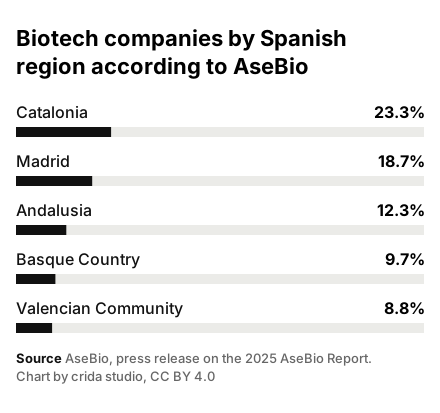
Catalonia ranks first, with 23.32% of biotech companies. Next come Madrid with 18.68%, Andalusia with 12.33%, the Basque Country with 9.65% and the Valencian Community with 8.85%. Together these five regions hold more than seven in ten companies in the sector.
For a supplier based in Catalonia, the home market is almost one in four Spanish biotechs, and the other three are elsewhere. That calls for Spanish-language content, Google Ads campaigns with regional targeting and a visit plan covering Madrid, Andalusia, the Basque Country and Valencia. For Catalonia itself, the BioRegion of Catalonia report goes into more detail.
| Region | Share of companies |
|---|---|
| Catalonia | 23.3% |
| Madrid | 18.7% |
| Andalusia | 12.3% |
| Basque Country | 9.7% |
| Valencian Community | 8.8% |
How many biotech companies are there in Spain?
According to the 2025 AseBio Report, there are 1,119 in 2025, up 10.4% on the previous year. Microenterprises make up 52% and SMEs 43.6%. Human health is the main field, with 55.5% of companies, and food is second with 32.6%.
Human health leads and food biotech is growing
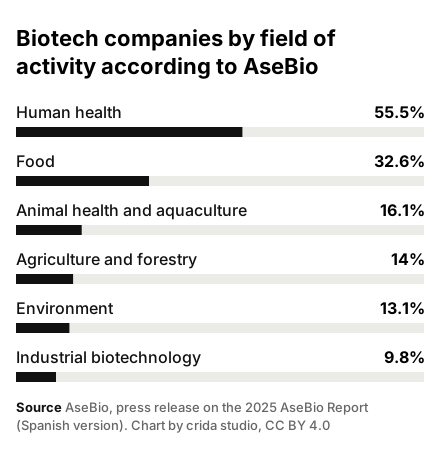
Human health is still the main field, with 55.5% of companies, down from 58% the previous year. Food comes second with 32.6%, up from 27% in 2023. Then come animal health and aquaculture, agriculture and forestry, the environment and industrial biotechnology.
If your website only talks about pharma, you miss a growing part of the market. A food company that runs fermentation or develops ingredients searches with different words and wants different examples. Build pages and case studies for each field you serve, in its own vocabulary, instead of one page for everyone.
| Field of activity | Share of companies |
|---|---|
| Human health | 55.5% |
| Food | 32.6% |
| Animal health and aquaculture | 16.1% |
| Agriculture and forestry | 14% |
| Environment | 13.1% |
| Industrial biotechnology | 9.8% |
Want to know whether your website speaks to small biotechs and food biotech companies? Leave us your details and we will take a look.
Take a lookRecord investment in 2025 and what it means for sales
Capital raised went from 181 million euros in 2024 to 408 million in 2025, a 125% increase. Deals rose from 52 to 59, with an average size of nearly 7 million euros. Capital increases involving international investors brought in 302 million across 12 transactions.
Biotech companies invested 1.46 billion euros in R&D in 2024, up 13.9%. Companies fund 67% of it from their own resources, and AseBio notes a significant rise in spending on physical infrastructure. For equipment suppliers, a closed round is a good moment to get back in touch, and a useful signal when you score startup leads in your CRM.
Which Spanish region has the most biotech companies?
Catalonia, with 23.32% of Spain's biotech companies. It is followed by Madrid with 18.68%, Andalusia with 12.33%, the Basque Country with 9.65% and the Valencian Community with 8.85%. For a supplier, the market goes well beyond Catalonia and Madrid, so plan for all five regions.
Partnerships with research centres mean two buyers
Spanish biotechs set up 266 partnerships in 2025. Of these, 168 were with research centres or foundations, 50 with other biotech companies and 40 with other types of companies. Working with research is by far the most common kind of partnership in the sector.
In practice, one project can have two buyers. The company pays or leads, while the research group uses the equipment and has its say. Prepare content for both, with datasheets and references for the group and cost and service arguments for the company. Trade shows such as BioSpain or Farmaforum are places where you can meet both.
What to change in your marketing plan
With these figures, a supplier can review its plan on five points. Most of them come down to putting each euro and each message in a better place. These are the points we look at when we build a marketing strategy for a supplier in the sector.
If you sell bioprocess equipment, consumables or services in Spain, biotech marketing has to start from this picture of the market. A generic list of pharma companies leaves out most biotechs, which are small and spread across the whole country.
- Segment campaigns and emails by region, starting with the five that have the most companies.
- Separate human health and food on your website, with their own pages, cases and keywords.
- Plan for micro firms and SMEs, with clear datasheets, entry options and a direct contact.
- Follow funding rounds and AseBio news to spot who may buy soon.
- Prepare material for the research centre that works with the biotech in a partnership.
How much investment did Spanish biotechs raise in 2025?
According to AseBio, 408 million euros across 59 deals, compared with 181 million in 2024. That is a record and a 125% increase. International investors played a key role, with 302 million in 12 capital increases, and CDTI Innvierte put 47.2 million into rounds at 10 companies.
How to read the AseBio figures
The AseBio release mixes years. Company numbers, capital raised and partnerships are for 2025. Income, share of GDP and R&D spending are for 2024. The food figure is compared with 2023. When you quote a figure in a presentation or on your website, always give the year.
The fields add up to more than 100% because one company can work in several. Biocat's report on Catalonia, by contrast, counts the 1,650 companies in the whole life sciences and health sector, with subsectors such as medtech and digital health. It uses a different scope, so its figures cannot be added to AseBio's or compared with them directly.
