

On this page
What the latest B2B buyer surveys say
Two Gartner surveys in a row point the same way. In the first, run in August and September 2024, Gartner asked 632 B2B buyers and 61% said they preferred an overall rep-free buying experience. In the second, run in August and September 2025, it asked 646 buyers and the figure rose to 67%. Of that second group, 45% had already used AI during a recent purchase.
The 2024 survey also shows why the website carries so much weight. Of the 632 buyers, 69% report inconsistencies between what a supplier's website says and what its sellers tell them. And 73% actively avoid suppliers who send irrelevant outreach.
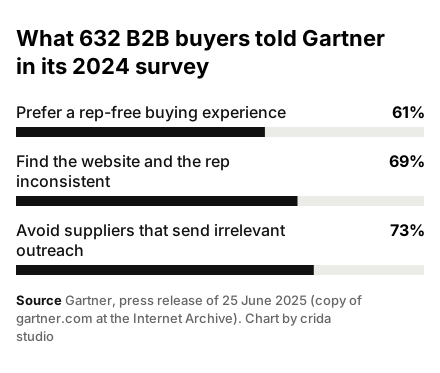
| What buyers say | Share |
|---|---|
| Prefer a rep-free buying experience | 61% |
| Find the website and the rep inconsistent | 69% |
| Avoid suppliers that send irrelevant outreach | 73% |
When buyers still want a sales rep
Buyers still want a rep, just later in the process. In the 2024 survey, Gartner found they favour online self-service for general information and for learning new things. They prefer seller input when a task needs context, such as working out whether a product fits their company's needs.
In bioprocess, the first half of the purchase usually happens on the website. An engineer comparing bioreactors or a TFF system wants working volumes, materials, documentation and lead times without having to ask. Once they can see the equipment might fit their process, they do want someone to talk through the URS, the FAT and scale-up. If the website does not cover the first half, it is hard to get to the second.
Do we have to publish equipment prices on the website?
You do not need a fixed price. If it depends on the configuration, explain what drives it, what is included and, if you can, give a range. That saves the first call and filters out poor fits. It also means the website and the rep say the same thing. In Gartner's 2024 survey of 632 buyers, 69% found inconsistencies between the two.
Thought leadership also helps you onto the shortlist
Expert content with a point of view counts when buyers decide who to invite to quote. Marketers call it thought leadership. The 2024 Edelman and LinkedIn report surveyed nearly 3,500 management-level professionals in seven countries. Among buyers, 86% say they are moderately or very likely to invite organisations that consistently publish it to take part in an RFP. Among the organisations producing it, only 38% expect that.
In the same survey, 73% see this kind of content as a more trustworthy basis for judging a company's competencies than its marketing materials. Yet only 15% rate what they read as very good or excellent. And 55% say the best content includes strong research and data. In bioprocess, that means application notes with real data, scale-up comparisons or test results.
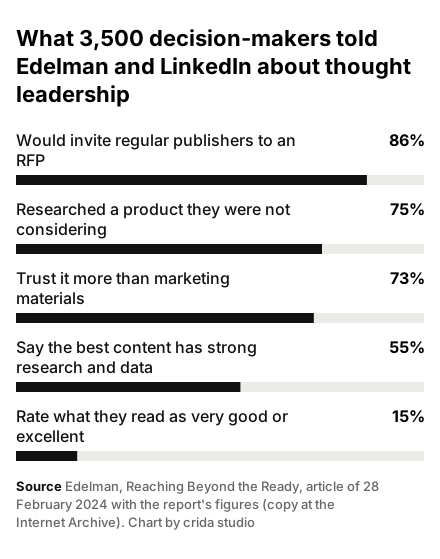
| What decision-makers say | Share |
|---|---|
| Would invite regular publishers to an RFP | 86% |
| Researched a product they were not considering | 75% |
| Trust it more than marketing materials | 73% |
| Say the best content has strong research and data | 55% |
| Rate what they read as very good or excellent | 15% |
Want us to check whether the technical content on your website helps you get onto shortlists? Leave your details and we will tell you what we would improve first.
Review my contentSeven answers the website must give before a rep gets involved
If most buyers want to move forward on their own, the website has to do the job of the first sales visit. For a bioprocess equipment or consumables supplier, that comes down to seven answers a buyer expects to find without filling in a form.
Price and lead time are the two answers that scare suppliers most. Every system is configured to order and delivery dates move. Yet in Gartner's 2024 survey, 69% of the 632 buyers found the website and the rep inconsistent. The simplest fix is for both to give the same facts.
- The price or a price range, or at least what it depends on and what is included.
- Specifications and the datasheet in HTML and PDF, with working volumes, product-contact materials and connections.
- Typical lead times for each equipment or consumable family.
- Validation documents such as IQ, OQ and PQ, FAT and SAT, material certificates, extractables and leachables data for single-use and 21 CFR Part 11 where there is software.
- Compatibility with what they already run, such as sensors, single-use bags and assemblies or the control system.
- References and applications where the equipment already runs, even when the customer cannot be named.
- Who will answer in each market, with a name, role and direct contact.
Are these surveys about bioprocess?
No. The Gartner surveys cover B2B buyers in general and the 2024 Edelman and LinkedIn report covers decision-makers in seven countries. They show where B2B buying is heading. To see what is happening in your market, ask your latest buyers what they had looked up before sending you a request for quotation.
New website or more trade shows. How to decide with this data
Trade shows and the website do different jobs. A show puts you in front of buyers who did not know you. The website is where they check what you told them at the stand and where buyers who prefer to move without a rep end up. If the seven answers are missing, they have to write to a rep. That is the very step 67% of the 646 buyers Gartner surveyed in 2025 would rather avoid.
If you run marketing at a mid-size European equipment maker, check whether the website says what you say at the stand in every language you sell in. If you are the only marketer at a life science supplier in Catalonia or elsewhere in Spain, remember that a show lasts a few days while the website works all year. Either way, fill the gaps on the website first. Then measure how many requests for quotation each show brings in.
Can weak technical content actually hurt us?
Yes. In an Edelman and LinkedIn survey of 1,300 decision-makers and C-suite executives, run in October and November 2016, 45% of decision-makers and 53% of C-suite executives said poor thought leadership had sometimes made them lose respect for the company behind it. And 30% and 35% respectively said it could also affect how much business they awarded.
How to check your website in an afternoon
Take your last ten requests for quotation and note what each buyer asked in their first message. Then look for each answer on your website the way they would. Start from Google and use a phone. Whatever you cannot find in two clicks is what you are forcing buyers to ask a rep about.
Compare the web page with the sales deck as well. If the PDF gives one working-volume range and the website another, that is the inconsistency reported by 69% of the 632 buyers Gartner surveyed in 2024. Once that is fixed, it makes sense to bring buyers in with SEO and campaigns. They will land on pages that answer and the rep will join conversations that have already started.
