
On this page
The screen exists to stop people walking past
The screen has one job, which is to make someone walking down the aisle understand what you do and stop. It does not need to cover the whole catalogue or replace your sales staff. If within a few seconds it is clear that you make single-use bioreactors that scale to production, or TFF systems for CDMOs, it has done its work.
That is why the corporate video from your website rarely works as it is. It usually has a voice-over, a slow opening and shots meant for someone sitting down. At a show, people look at you while walking, from a distance and with noise all around, and anything that does not land at first glance is lost.
Design it for no sound and for reading from three metres
Audio is hard to hear in an exhibition hall, so everything has to work as picture and text. Use short phrases, large type and strong contrast, and leave each line on screen long enough to be read twice. One idea per shot and no small data tables.
If someone speaks on camera, use open captions, the kind that are always displayed and cannot be turned off, as the W3C accessibility initiative describes them. Before you sign off the edit, play it on a real screen from three metres away with the volume at zero. Anything that does not make sense that way should go.
How long should a booth loop video be?
There is no single number. What matters is that each segment makes sense on its own, because nobody watches it from start to finish. A short loop repeats more often and gives you more chances to catch someone. If the edit grows because you want to cover the whole range, split it into several loops for different screens.
How to structure the loop
A loop has no beginning, because everyone catches it at a different point. Each segment has to make sense on its own and the brand has to be visible the whole time, not just at the end. A structure that tends to work for bioprocess equipment looks like this.
- The full unit in a clean shot, with the product name and scale.
- A 3D cutaway of what happens inside, such as mixing, sparging or flow across the membrane.
- The problem it solves in one line, for example scaling from lab to production on the same platform.
- A real detail, such as a single-use bag change or the control screen.
- The brand and a QR code that leads to the product page.
Should the booth video have music or a voice-over?
In an exhibition hall it will usually go unheard. If you have an enclosed area or give presentations on the booth with a microphone, sound can work there. For the screen facing the aisle, design for silence from the start and keep music for the website or social versions.
Want us to look at the video now running on your booth? Leave your details and we will tell you what we would change so it reads from the aisle.
Review my video3D cutaways to show what cannot be seen
A stainless steel vessel or a single-use bag shows nothing of what happens inside. A 3D animation can open up the unit, show the impeller turning, the bubbles from the sparger or the tangential flow over the membrane, and put lab, pilot and production scale side by side so buyers see the whole family.
David Monje, founder of crida studio, took TECNIC Bioprocess Solutions' technical content into 3D, animation and interactive tools while he led its marketing. The same 3D model can feed the booth video, catalogue images and an online configurator, which brings down the cost of every new piece.
3D render or real footage of the equipment?
Both. Real footage of the plant, the cleanroom or the unit running builds credibility, and 3D shows the inside, the flow and the scale that a camera cannot capture. If the unit is not built yet or is too large to film well, 3D lets you have the video ready in time for the show.
Format and file, ask before you edit
Ask your stand builder for the size and orientation of every screen, the resolution, the media player and the file format it accepts. A vertical LED wall, a totem and a landscape TV each need a different edit, and reworking it on the last day rarely goes well.
Deliver the file early and test it on the actual screen. Check that the loop does not flash black when it restarts, that brightness does not blow out the whites and that text reads under the hall lighting. Bring a copy on a USB stick just in case.
Can we reuse the booth video on our website?
Yes, but make a version meant for the web. The product page can carry a slightly longer cut with subtitles or voice, a clear thumbnail and, for an important video, its own watch page so Google can show it. On LinkedIn, a short square or vertical cut works better.
The same edit for LinkedIn and the product page
Short social versions come straight out of the loop. For video ads, LinkedIn recommends landscape, square or vertical formats, a length of 15 to 30 seconds, putting the most impactful content in the first 10 seconds and adding subtitles. Because the loop is already built for no sound, the adaptation is quick.
On the product page, Google needs the video embedded on the page with a thumbnail at a stable URL, and recommends a dedicated watch page for each video where it makes sense, plus structured data. Below is an example of a short product piece that can work on the website, on social media and at a show.
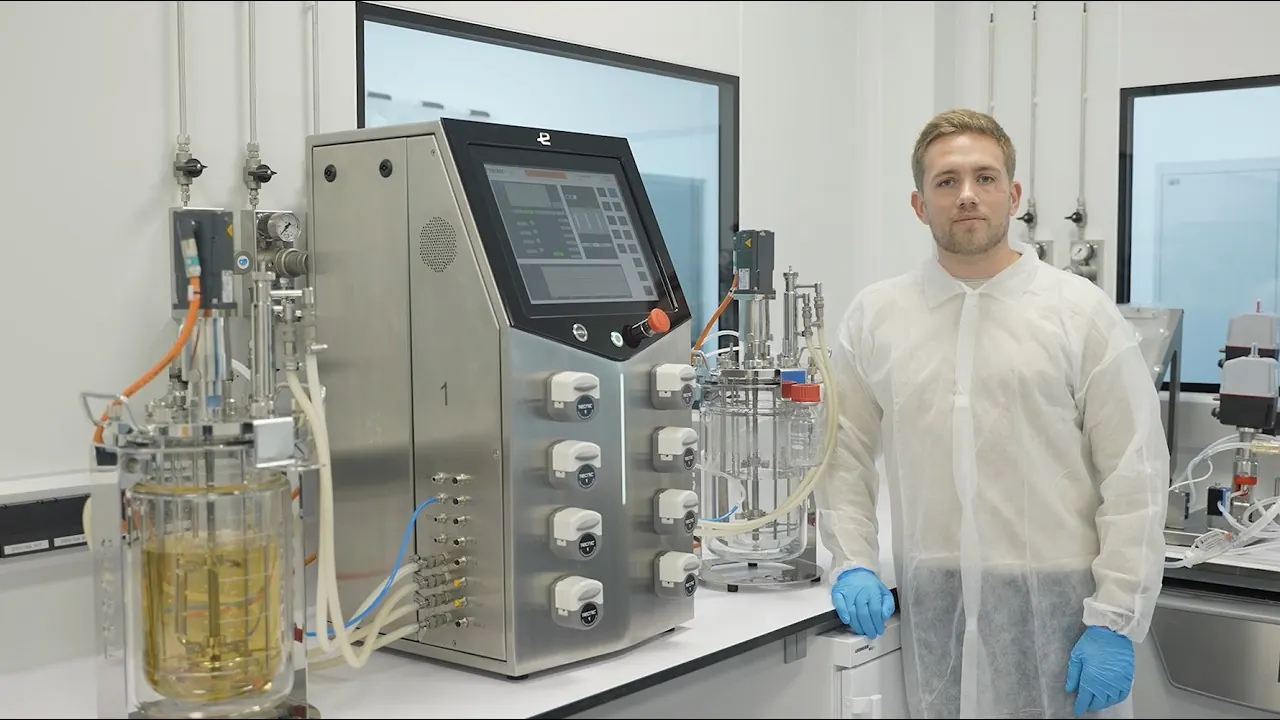 Play the video. Bioprocess equipment for laboratories - TECNIC
