

On this page
Where to start
Trade shows give reach, roadshows give depth
The main difference is who is standing in front of you. A show brings a stream of people you do not know, with short and noisy conversations. On a roadshow you pick the list, travel to the customer's city, a distributor's lab or the customer's own site, and the demo can take as long as it needs.
So the useful question is where your accounts are in the buying process. If you still need to find them, go to the show. If you already know them and they are torn between two suppliers, take the roadshow. A small sales team cannot do everything, and the wrong choice also costs your people's time.
What an international show like ACHEMA gives you
A major show packs buyers from many countries into a few days. According to the official figures, ACHEMA 2024 drew 106,001 participants and 2,842 exhibitors from 56 countries, and for 52 percent of visitors it is the only trade show they attend. The next edition runs from 14 to 18 June 2027 in Frankfurt.
Look at where the audience comes from as well. At ACHEMA 2024, 51.1 percent of participants came from Germany and only 7.4 percent from Southern Europe. If your main market is Germany, it fits. If you are looking for customers in Spain, a local show or a roadshow may pay off better.
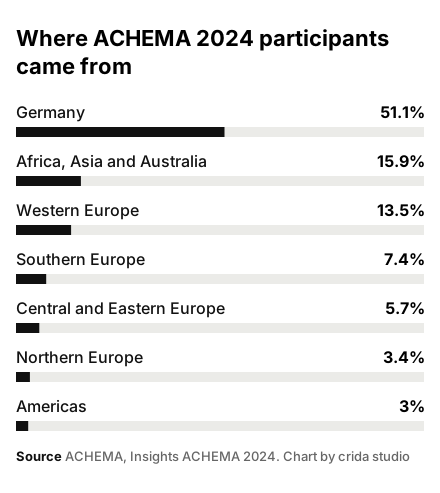
| Origin | Participants |
|---|---|
| Germany | 51.1% |
| Africa, Asia and Australia | 15.9% |
| Western Europe | 13.5% |
| Southern Europe | 7.4% |
| Central and Eastern Europe | 5.7% |
| Northern Europe | 3.4% |
| Americas | 3% |
What equipment can we take on a roadshow?
Anything that fits in a van and can be set up in a few hours, such as lab bioreactors, benchtop TFF systems, single-use bags and assemblies or the control software on a screen. For production scale, use a 3D configurator, a process animation or a visit to a reference site if the customer allows it.
Want us to check whether your next trade show matches the markets you are after? Leave your details and we will tell you what we would do before booking.
Check my showWhat a demo roadshow gives you
A roadshow takes the demo to people who already have a need. A lab bioreactor, a benchtop TFF system or single-use consumables can travel, and the customer can bring their process, QA and procurement people. Production-scale equipment is hard to move, but a 3D configurator or a process animation can explain large scale.
David Monje, founder of crida studio, led marketing at TECNIC Bioprocess Solutions for four and a half years. International trade shows were his test bench there, and he organised TECNIC's presence at the #MEVO 2024 event, with the interactive showroom and the equipment shown in the summary video TECNIC published on 7 May 2024.
 Play the video. Exploring the Future of Biotech with TECNIC at #MEVO 2024 | An Exclusive Insight
Can a roadshow replace a trade show?
Rarely in full. A roadshow needs a list of accounts to visit, and much of that list is built at trade shows, through SEO, campaigns and distributors. If you skip a show one year, make up for it with extra effort to find new names, or the roadshow will run out of people to visit.
Trade show or roadshow, criterion by criterion
The table sums up what changes for an equipment maker. Cost per useful meeting varies a lot from case to case, so work it out with your own numbers, adding up booth, travel, equipment shipping and staff hours, then dividing by the meetings that turned into real opportunities.
| Criterion | International trade show | Demo roadshow |
|---|---|---|
| Reach | Many new buyers from many countries | A few accounts you choose |
| Audience control | Low, whoever walks by | High, only the people you invite |
| Demo depth | Short and noisy | Long, with data from the customer's process |
| Team time | A few intense days plus build-up | Many stops with travel and shipping |
| Buying stage | When the customer is still looking for suppliers | When they are comparing two or three options |
| What to measure | Booked meetings and new opportunities | Opportunities that move forward and quotes |
How do we work out cost per meeting for each format?
Add up every cost of the format, including booth or meeting rooms, travel, equipment shipping and people's hours, and divide it by the meetings that produced a real opportunity in the CRM. Compare formats on the same basis and over a full year, because equipment sales take months to close.
A yearly calendar that combines both
A practical option is to make one major show the anchor and build the roadshow around it. Before the show, a few stops to invite key accounts to the booth. Afterwards, stops in the markets that produced the most opportunities, often with the local distributor, who knows the customers and can lend you a room or a lab.
Build one kit that serves everything, with the demo unit, the booth loop video, data sheets in English and in the local language and a twenty-minute demo script. And tag the source of every contact in your CRM, so after a year you can compare what each format actually brought in.
Should we run the roadshow with our distributors?
In countries where you sell through distributors, yes. They know the customers, can fill the room and will handle the follow-up. Prepare the content and the demo, let the distributor send the invitations and agree beforehand who calls each attendee and by when.
